
Visualizing Indian Railways Revenue, Profit and Performance
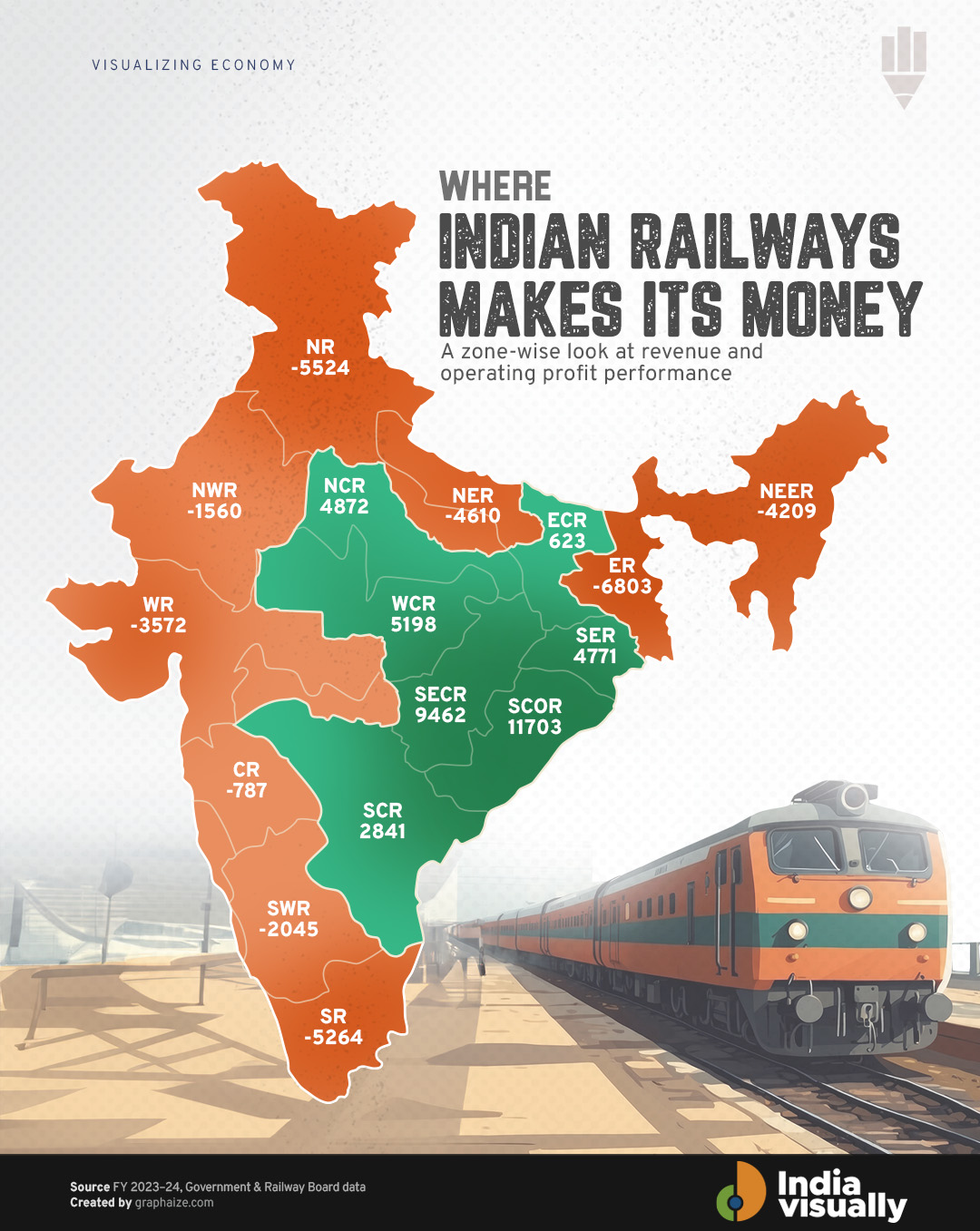
Few institutions capture the scale and spirit of India like the Indian Railways. Stretching across more than 68,000 kilometers and connecting nearly every corner of the country, this massive network doesn’t just move people — it moves the nation’s economy. But have you ever wondered where Indian Railways makes its money?
In this blog, we take a closer look at Indian Railways revenue, analyzing how different zones perform, which ones make profits, and which struggle to balance the books. Let’s unpack the numbers and understand what drives this colossal system financially.
The Backbone of India’s Economy
Indian Railways is more than a transport network — it’s an economic engine. Employing over 1.2 million people, it’s one of the largest employers in the world and contributes significantly to India’s GDP.
Each day, over 23 million passengers travel on its trains, and freight trains carry millions of tons of goods — from coal and cement to fertilizers and consumer goods. Naturally, this massive movement translates into equally massive financial figures.
But the story isn’t evenly distributed. Some zones are thriving with freight-driven profits, while others operate at a loss, primarily due to heavy passenger subsidies.
Understanding Indian Railways Revenue Sources
Before diving into the zone-wise analysis, it’s essential to understand where Indian Railways revenue actually comes from.
Broadly, the earnings can be divided into two categories:
Freight Revenue
Freight is the real money-maker for Indian Railways. Around 65%–70% of total revenue comes from transporting goods. Coal, iron ore, cement, petroleum, and food grains are major contributors. Freight trains, unlike passenger trains, have predictable routes, high demand, and fewer subsidies — making them a reliable source of income.
Passenger Revenue
Passenger services form the emotional core of the Railways but are less profitable. While they account for nearly 25–30% of total revenue, the operating costs and subsidized fares mean that passenger operations often run at a loss.
Additionally, suburban and short-distance services — especially in metro-linked regions like Mumbai, Delhi, and Chennai — further lower profitability due to low ticket prices and high maintenance needs.
Zone-Wise Analysis of Indian Railways Revenue
To truly understand Indian Railways revenue performance, it’s vital to look at it zone by zone. The Railways is divided into 17 zones, each managing its operations independently but contributing to the overall national network.
Let’s visualize where the money flows.
The Profit-Making Zones: Where Trains Turn Green
When it comes to profitability, a handful of zones stand out for driving the bulk of Indian Railways revenue. Leading the charge is the South Central Odisha Region (SCOR), which tops the chart with an impressive profit of around ₹11,703 crore. Its proximity to mining belts and ports makes it a powerhouse for freight operations, especially in minerals and exports.
Close behind is the South East Central Railway (SECR), earning about ₹9,462 crore in profit. With its routes passing through industrial hubs in Chhattisgarh and Odisha, SECR benefits from heavy coal and iron ore traffic, making it one of the most freight-dominant zones in the country.
The West Central Railway (WCR) and South Eastern Railway (SER) also show strong financial health, earning approximately ₹5,198 crore and ₹4,771 crore respectively. Their strategic positioning in central and eastern India allows them to handle high freight volumes efficiently, connecting industrial and mining regions to ports and major cities.
Meanwhile, the North Central Railway (NCR) and South Central Railway (SCR) maintain steady profits of ₹4,872 crore and ₹2,841 crore, balancing both passenger and freight services. NCR’s busy corridors in northern India, combined with SCR’s industrial activity in states like Telangana and Andhra Pradesh, help sustain consistent growth.
Collectively, these zones form the financial backbone of Indian Railways — leveraging strong industrial linkages, optimized logistics, and efficient freight management to keep the network’s revenue on track.
The Loss-Making Zones: The Red Side of the Track
While several zones keep the Indian Railways revenue figures in the green, others continue to operate deep in the red — primarily due to high passenger loads, subsidized fares, and limited freight opportunities. At the top of this list is the Eastern Railway (ER), which recorded a loss of nearly ₹6,803 crore. Serving some of the most densely populated regions of West Bengal and eastern India, ER handles heavy passenger traffic but struggles to generate sufficient freight income to offset operating costs.
The Northern Railway (NR) and Southern Railway (SR) follow with losses of ₹5,524 crore and ₹5,264 crore, respectively. NR, which covers the bustling Delhi and northern corridor, faces massive suburban and intercity passenger volumes that strain infrastructure and resources. Similarly, SR — spanning Tamil Nadu and Kerala — operates numerous daily services catering to dense urban populations but lacks the freight movement needed to stay profitable.
The Western Railway (WR), despite connecting major commercial hubs like Mumbai and Gujarat, incurs a loss of ₹3,572 crore, largely due to its extensive suburban network. These local train services are crucial for millions of commuters but generate minimal revenue compared to their maintenance and energy costs.
In the north and south, smaller zones like the North Eastern Railway (NER), South Western Railway (SWR), and North Western Railway (NWR) also report significant losses — ₹4,610 crore, ₹2,045 crore, and ₹1,560 crore, respectively. Challenging terrain, limited freight potential, and ongoing infrastructure expansion mean these regions spend more than they earn.
Together, these loss-making zones highlight the Railways’ social commitment — prioritizing accessibility and connectivity over profitability. They remind us that the Indian Railways isn’t just a business; it’s a public service that keeps the nation moving, even when the balance sheets say otherwise.
Freight vs. Passenger: The Real Decider
The Indian Railways revenue structure heavily leans on freight, which accounts for nearly 70% of total income. Yet, passenger services are vital for accessibility and national connectivity — even if they’re not financially lucrative.
Freight trains run fewer services but earn more per kilometer. Passenger trains, on the other hand, are numerous but less profitable. The operating ratio — a measure of how much is spent to earn ₹1 — shows that freight operations have an edge, often hovering near 90%, while passenger services go well beyond 100%, indicating losses.
Why Some Zones Succeed While Others Struggle
Let’s decode the reasons behind the uneven financial performance across zones:
Freight Access: Zones near ports, mines, and industrial belts (like SECR, SCOR, SER) dominate profits.
Urban Density: Zones serving high-density metro routes incur more costs due to frequent services and infrastructure wear.
Passenger Subsidies: Indian Railways maintains affordable fares, especially for lower-income groups, impacting overall revenue.
Operational Efficiency: Modernization, electrification, and route optimization play major roles in improving profit margins.
Conclusion: The Journey Toward a Stronger Financial Track
The Indian Railways remains one of the most fascinating case studies in public sector management. Its massive reach, diverse geography, and complex balance of profit and purpose make it unique.
The visualization of Indian Railways revenue shows a clear pattern — freight-oriented zones drive the profits, while passenger-heavy ones sustain the social mission. Both are essential to keep the network running and the country connected.
As modernization and digital transformation continue, the goal isn’t just to make money — it’s to make every journey count, economically and socially.
Unlock the power of captivating visuals with our seasoned expertise! With 7 years of crafting compelling visual content, we’re ready to elevate your brand’s story. From stunning graphics to mesmerizing animations, we bring your vision to life. Let’s create engaging visuals that resonate with your audience and leave a lasting impression. Partner with us today for an unforgettable visual journey!