
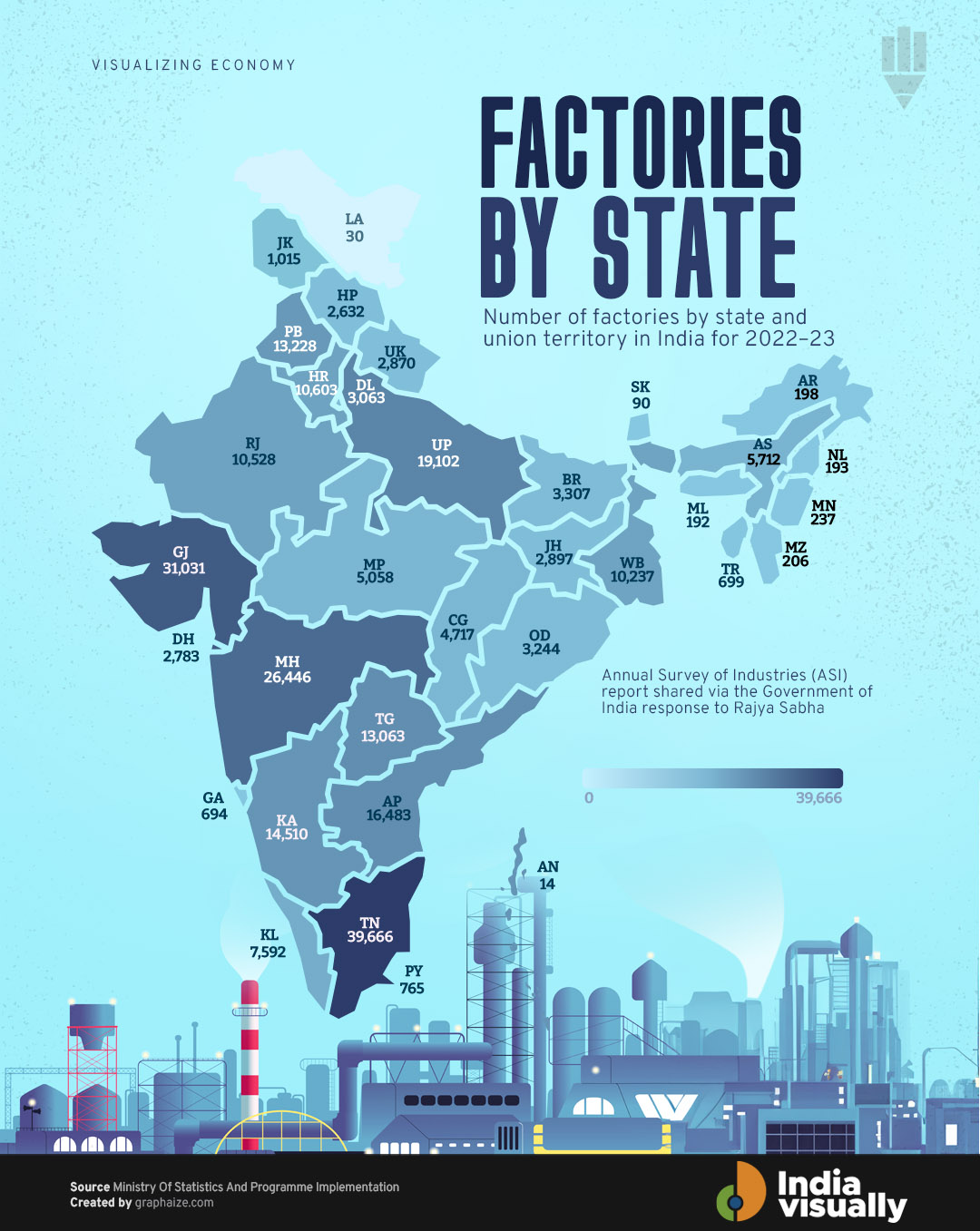
India’s industrial base has always been one of its biggest strengths, and in recent years, the country’s manufacturing sector has only grown more significant. From automobiles to textiles, chemicals to construction materials, the diversity of what is produced across the nation is remarkable. But here’s the real question—which states are leading the charge, and how does the distribution of industries vary across India? That’s where analyzing factories by state in India becomes so important.
In this blog, we’ll break down the latest 2022–23 data to uncover where factories are located, which sectors dominate, and why these statistics matter for the economy, employment, and policy-making.
Why Tracking Factories by State in India Matters
Before diving into numbers, let’s talk about why this topic deserves attention. State-wise factory data is more than just statistics—it tells us about economic balance, job opportunities, infrastructure development, and even regional disparities.
Employment generation: Millions of Indians depend on factory jobs. Whether it’s a steel plant in Odisha or a textile mill in Tamil Nadu, factories are a lifeline for working families.
Exports and trade: Many of India’s top exports—petroleum products, automobiles, chemicals—come directly from factories.
Investment decisions: Businesses and governments use these insights to decide where to build new industrial clusters.
Regional growth: Factories bring infrastructure, logistics hubs, and better connectivity to states, reducing economic inequality.
India’s Industrial Landscape in 2022–23
The Annual Survey of Industries (ASI) 2022–23 gives us a clear picture of India’s industrial spread.
- India had around 2.5 lakh operational factories during this period.
- Together, these factories contributed nearly ₹22 trillion in value added to the economy.
- Just a few sectors-basic metals, chemicals, and petroleum products—accounted for nearly one-third of total value added.
- The top 10 products alone represented more than 20% of India’s total industrial output.
This tells us two things: India’s industrial base is huge, but it’s also concentrated in certain states and sectors.
Factories by State in India: The Leaders
So, which states top the charts when it comes to industrial presence? Let’s explore.
Tamil Nadu: The Manufacturing Powerhouse
Tamil Nadu consistently ranks at the top (39,666) in terms of the number of factories. With strong roots in textiles, automobiles, and electronics, the state has become a global manufacturing hub. Cities like Chennai and Coimbatore are buzzing with industrial activity, producing everything from cars to clothing.
Maharashtra: India’s Industrial Giant
Maharashtra doesn’t just have numbers—it has scale. The state is home to thousands of factories across chemicals, petroleum, textiles, and engineering. Mumbai, Pune, and Nagpur act as magnets for industrial investment, making Maharashtra a true economic engine.
Gujarat: The Petrochemical and Textile Leader
Gujarat is famous for its petrochemical and chemical industries, but that’s not all. With a thriving textile base and a booming automobile sector (hello, Sanand and Halol plants), Gujarat has positioned itself as a manufacturing magnet.
Uttar Pradesh: Rising in Numbers
While traditionally agrarian, Uttar Pradesh has witnessed a steady increase in factories. Food processing, leather goods, and electronics assembly units are gaining ground, especially near Noida and Kanpur.
Andhra Pradesh & Telangana: South India’s Growth Engines
Both states have focused heavily on infrastructure and industrial parks. From pharma clusters in Hyderabad to heavy industries near Visakhapatnam, these regions are building a reputation for innovation-driven manufacturing.
Karnataka: Tech Meets Industry
Karnataka, especially Bengaluru, is often linked with IT, but the state also has a growing industrial side. Electronics, aerospace, and heavy machinery factories contribute significantly to the state’s output.
Union Territories and Their Role
When discussing factories by state in India, we shouldn’t ignore the union territories. While smaller in size, some play a surprisingly big role.
Delhi: Limited in factory numbers but strong in services and smaller manufacturing clusters.
Puducherry: Known for textiles, leather, and chemicals.
Dadra & Nagar Haveli and Daman & Diu: Significant in small-scale manufacturing, plastics, and textiles due to favorable policies.
Chandigarh: Focused on light engineering and consumer goods.
Sectoral Highlights: What Are These Factories Producing?
It’s not just about where factories are—it’s also about what they produce.
| Category | Function |
|---|---|
| Basic Metals | From raw steel to alloys, this sector is a backbone for construction and exports. Odisha, Jharkhand, and Chhattisgarh dominate here. |
| Chemicals and Petroleum | Whether it’s fuels, plastics, or fertilizers, these factories keep other industries running. Gujarat, Maharashtra, and Tamil Nadu are the key players. |
| Automobiles | Tamil Nadu, Maharashtra, and Gujarat lead India’s auto manufacturing revolution, producing cars, two-wheelers, and auto parts for global markets. |
| Construction Materials | Cement and bricks are in massive demand due to India’s infrastructure drive. States like Andhra Pradesh and Rajasthan dominate this space. |
Regional Imbalances in Factories by State in India
Here’s the catch—factory distribution isn’t uniform.
- Nearly half of India’s factories are concentrated in just five states.
- Some states like Bihar, Jharkhand, and the North-Eastern states lag behind in industrial presence.
- This uneven growth creates employment and income disparities across regions.
For India’s economy to grow inclusively, there’s a pressing need to spread industries more evenly.
Even with progress, factories face hurdles.
Environmental concerns: Heavy industries add to pollution and waste management issues.
Global competition: Countries like China and Vietnam challenge India’s position as a low-cost manufacturing hub.
Infrastructure gaps: Power, logistics, and port facilities still need upgrades in many states.
Skilled labor shortages: Automation and advanced manufacturing demand more trained workers than ever.
The Road Ahead for India’s Industrial Growth
India has ambitious goals—becoming a $5 trillion economy and positioning itself as a global manufacturing hub. Achieving this requires:
- Better infrastructure and logistics across states.
- Skill development programs to prepare workers for high-tech industries.
- Encouraging green manufacturing to balance growth with sustainability.
- Policies that push industries into underdeveloped regions, reducing the regional imbalance.
The takeaway? Factories aren’t just industrial units—they are engines of employment, exports, and empowerment. And by looking at them state by state, we get a clearer picture of India’s industrial future.
Analyzing factories by state in India gives us a powerful lens to understand where the country’s economy stands and where it’s heading. While states like Tamil Nadu, Maharashtra, and Gujarat dominate, the potential for other regions is enormous. With the right mix of investment, policy, and infrastructure, India can achieve not just growth, but balanced and inclusive growth across states and union territories.
The takeaway? Factories aren’t just industrial units—they are engines of employment, exports, and empowerment. And by looking at them state by state, we get a clearer picture of India’s industrial future.
Unlock the power of captivating visuals with our seasoned expertise! With 7 years of crafting compelling visual content, we’re ready to elevate your brand’s story. From stunning graphics to mesmerizing animations, we bring your vision to life. Let’s create engaging visuals that resonate with your audience and leave a lasting impression. Partner with us today for an unforgettable visual journey!