
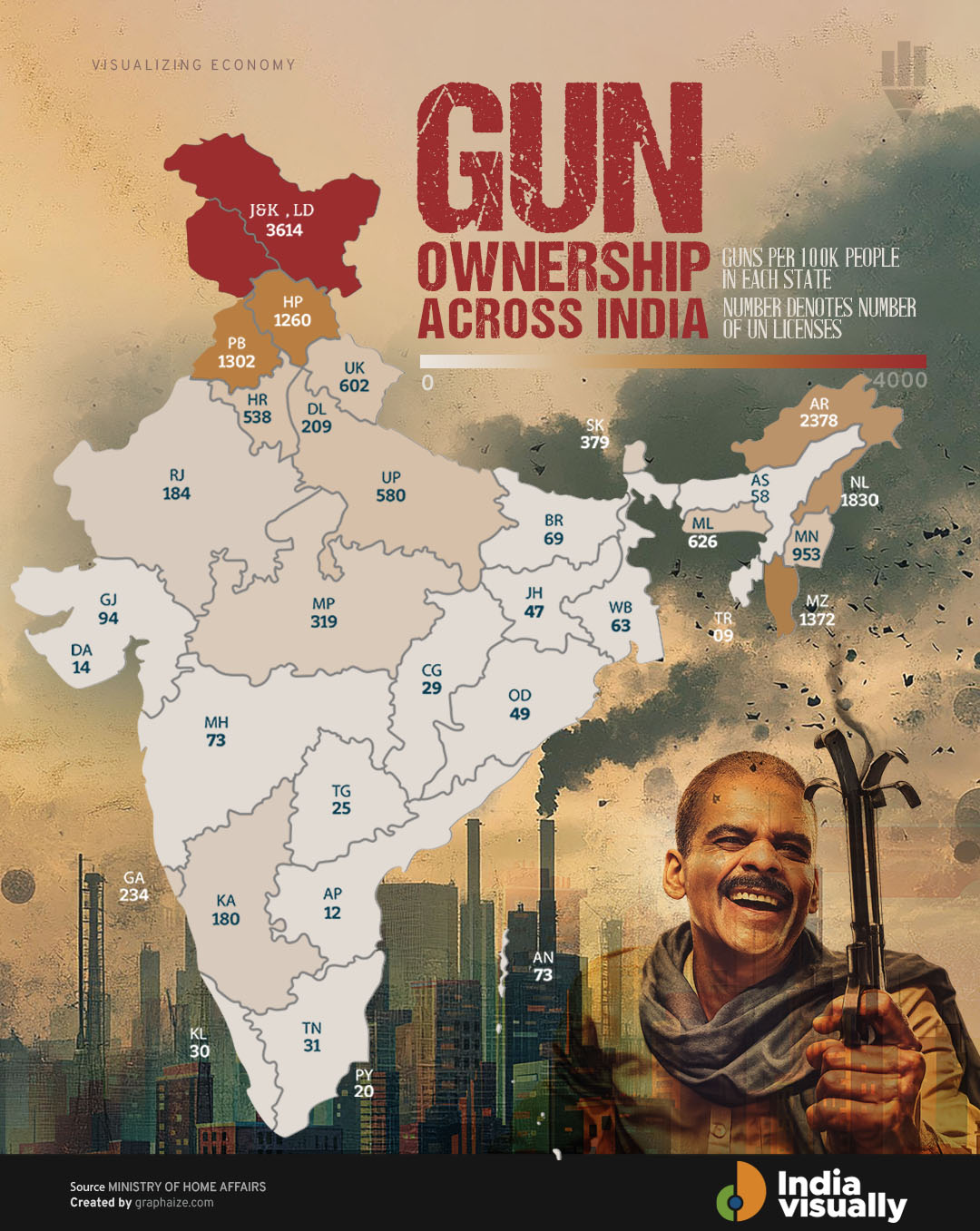
When people discuss gun ownership globally, the focus often shifts toward countries like the United States. However, understanding firearms ownership in India requires looking at the country’s unique legal system, population scale, and regional differences.
Unlike some countries where gun ownership is widespread, India follows a strict licensing framework. Civilian firearms are regulated under the Arms Act, 1959, which requires individuals to obtain official permission before owning a firearm.
To better understand firearm ownership patterns, analysts often use a metric called licensed guns per 100,000 people. This measurement helps explain how firearm ownership varies across regions while accounting for population differences.
It is important to clarify that discussions of firearms ownership in India typically focus only on legally licensed firearms. The data does not include illegal or unregistered weapons, which are outside the scope of official statistics.
Understanding Guns Per 100,000 People
One of the most common ways to measure firearm ownership is by calculating the number of licensed guns per 100,000 people.
This metric standardizes gun ownership data across different regions. Instead of simply counting how many firearms exist in a state, analysts compare that number to the state’s population.
The formula is simple:
Using this method allows researchers to compare firearm ownership between large and small states fairly.
For example, a state with 40,000 licensed guns may appear heavily armed. But if that state has a population of 50 million people, the ownership rate per person may actually be quite low. Population size plays a critical role in understanding firearm distribution.
This is why analysts prefer per-capita firearm ownership rates instead of raw gun totals. The rate provides a clearer picture of how common licensed firearms actually are within a population.
Data Sources (Important for Credibility)
Reliable analysis of firearms ownership in India depends on trustworthy data sources.
The primary source of firearm licensing data is the National Crime Records Bureau. This government agency publishes official reports that include statistics on arms licenses in force, representing legally issued firearm permits across the country.
These figures show how many firearms are officially registered under India’s licensing system.
To calculate firearm ownership rates per population, analysts also rely on demographic data from the Census of India (2011). Census figures provide the population base needed to compute gun ownership rates per 100,000 people.
Together, these two sources create a structured dataset for evaluating firearm ownership patterns across Indian states.
State-Wise Firearms Ownership in India
Firearms ownership in India varies significantly from state to state. While the national average remains relatively low, certain regions show higher concentrations of licensed firearms. Looking at licensed guns per 100,000 people helps reveal which states have higher or lower firearm ownership rates.
States With the Highest Licensed Guns Per 100,000 People
| Rank | State / Region | Licensed Guns per 100,000 People |
|---|---|---|
| 1 | Jammu & Kashmir (including Ladakh) | 3,614 |
| 2 | Arunachal Pradesh | 2,378 |
| 3 | Nagaland | 1,830 |
| 4 | Mizoram | 1,372 |
| 5 | Punjab | 1,302 |
These states show significantly higher firearm ownership rates compared to the national average. In some cases, regional security concerns, border proximity, and historical factors have influenced firearm licensing patterns.
States With the Lowest Licensed Guns
| Rank | State | Licensed Guns per 100,000 People |
|---|---|---|
| 1 | Tripura | ~9 |
| 2 | Andhra Pradesh | ~12 |
| 3 | Telangana | ~25 |
| 4 | Kerala | ~30 |
| 5 | Tamil Nadu | ~31 |
States with lower firearm ownership rates often have stricter administrative controls on gun licensing. Urbanization and different cultural attitudes toward firearm possession may also contribute to lower demand for civilian firearms.
Regional Patterns
A noticeable pattern in India’s firearm ownership landscape is the relatively higher licensed gun density in Punjab and several Northeastern states. These regions often have unique historical and geographic contexts that influence firearm licensing. Border areas, past security challenges, and rural traditions sometimes contribute to higher levels of licensed firearm ownership.
Why Some States Have Higher Gun Ownership
The distribution of firearms in India is shaped by several interconnected factors.
Historical and Regional Influences
In some states, firearm ownership has historical roots linked to land protection, local conflicts, or political movements. Over time, these traditions influenced how communities view firearm possession.
Cultural Attitudes Toward Guns
In regions such as Punjab, firearms sometimes hold cultural significance. Guns may be associated with rural identity, family tradition, or ceremonial status.
Border Regions and Security Concerns
States located near international borders may show higher firearm ownership rates due to security concerns or past insurgency activity. This is particularly visible in parts of the Northeast and Jammu & Kashmir.
Rural vs Urban Differences
Rural areas often have higher firearm ownership compared to major cities. In agricultural regions, firearms may be licensed for crop protection or personal security. Urban environments typically show lower ownership due to stricter scrutiny and reduced practical need.
India vs Global Gun Ownership
Globally, India ranks relatively low in civilian firearm ownership compared to many countries.
For example, the United States has one of the highest civilian gun ownership rates in the world, with more than 100 firearms per 100 people. In contrast, India’s licensed firearm ownership rate is significantly lower.
Part of this difference stems from regulatory frameworks. India maintains strict firearm licensing requirements, while laws in some countries allow broader civilian access.
It is also important to distinguish between legal firearm ownership and total gun presence. Official Indian statistics only account for firearms that have been legally licensed and registered.
Gun Laws and Licensing in India
Firearms in India are regulated under the Arms Act, 1959, one of the primary laws governing civilian access to guns in the country. The legislation was introduced to ensure that firearm possession remains strictly controlled and monitored by authorities. Unlike some countries where gun ownership is relatively common, India requires civilians to obtain an official license before purchasing or possessing a firearm.
To apply for a firearm license, individuals must submit an application to their local district authority. The process typically involves background checks, police verification, and administrative review. Authorities assess factors such as criminal history, personal security concerns, and the applicant’s reason for requesting a firearm.
Licenses are generally issued for specific purposes, including self-defense, crop protection in rural areas, and sport shooting or recreational use. Final approval is granted only after careful scrutiny by district officials and oversight from the Ministry of Home Affairs.
This multi-step licensing process is designed to keep firearm ownership regulated and ensure that guns remain in responsible hands.
Key Takeaways
Several important insights emerge when examining firearms ownership in India.
First, India has relatively low firearm ownership compared to many countries worldwide. Strict licensing laws contribute to lower civilian gun density.
Second, firearm ownership varies significantly between states. Regions such as Punjab and several Northeastern states show higher licensed firearm rates, while many southern states report very low ownership levels.
Finally, it is essential to remember that official statistics reflect licensed firearms only. These figures represent legal gun ownership and do not account for illegal or unregistered weapons.
Understanding firearms ownership in India therefore requires examining legal data, population context, and regional differences rather than relying on raw numbers alone.
Unlock the power of captivating visuals with our seasoned expertise! With 7 years of crafting compelling visual content, we’re ready to elevate your brand’s story. From stunning graphics to mesmerizing animations, we bring your vision to life. Let’s create engaging visuals that resonate with your audience and leave a lasting impression. Partner with us today for an unforgettable visual journey!