
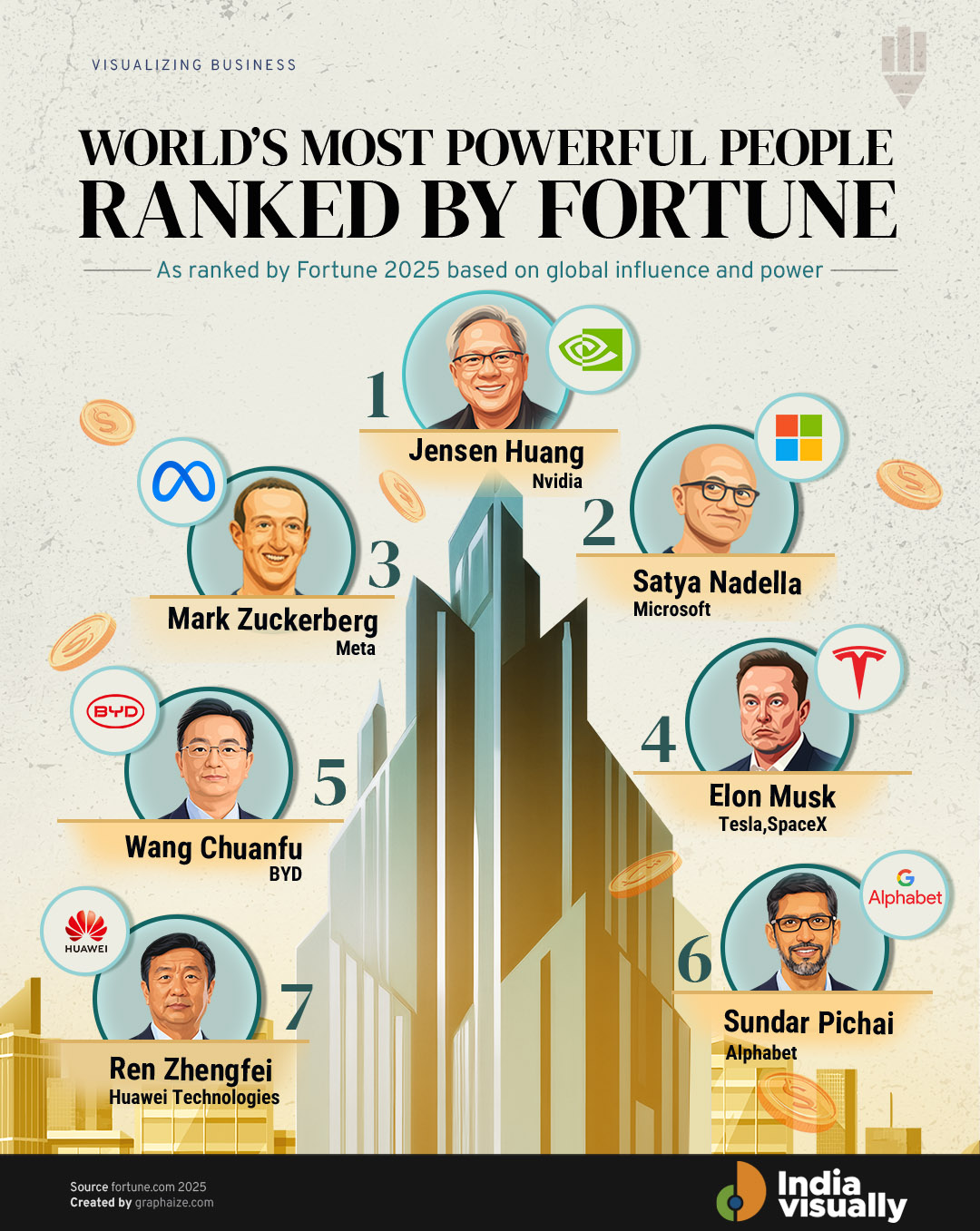
Power in today’s world doesn’t come from titles alone. It comes from global influence—the ability to shape industries, control critical technology, and steer outcomes that affect billions of people. That’s exactly what the Fortune ranking of the world’s most
powerful people focuses on.
Unlike wealth lists, Fortune looks at who actually moves the system. Who controls the infrastructure behind AI? Who influences how businesses operate, how governments think, and how technology evolves? In 2025, that power is concentrated in the hands of a few business leaders whose decisions ripple across the global economy.
Let’s break down the individuals who dominate this conversation—and why Fortune sees them as the most powerful people shaping the world right now.
How Fortune Measures Global Influence and Power
Before diving into names, it’s worth understanding how Fortune defines power. The ranking isn’t about net worth or popularity. Instead, it’s about control, scale, and impact. Fortune evaluates how much influence a leader has over people, capital, platforms, and outcomes.
In a world increasingly driven by AI, cloud infrastructure, electric vehicles, and geopolitics, leaders who sit at these intersections naturally rise to the top. Their power isn’t abstract—it’s operational. When they make a decision, markets shift, supply chains react, and competitors scramble.
Technology and AI Leaders Driving Fortune’s Business Power Ranking
Jensen Huang
Jensen Huang’s journey is a lesson in long-term vision. Over four decades, he transformed Nvidia from a graphics-chip company for gamers into the backbone of the global AI economy. Today, Nvidia’s GPUs have effectively replaced CPUs as the core engines of modern computing, powering everything from large language models to advanced robotics.
Demand for Nvidia hardware is intense. Hyperscalers are ordering tens of thousands of GPUs to build massive AI data centers. Even U.S. export controls that briefly disrupted sales to China couldn’t slow Nvidia for long. Policy reversals allowed continued shipments of specialized chips like the H20, reinforcing how essential the company has become. Under Huang’s leadership, Nvidia is also expanding beyond hardware into software, cloud platforms, and AI models—tightening its grip on the entire AI stack.
Satya Nadella
Satya Nadella has quietly engineered one of the most successful transformations in modern business. He led Microsoft from its PC-era roots into cloud computing and now deep into artificial intelligence. That evolution reshaped not just Microsoft, but how enterprises around the world operate.
An early partnership with OpenAI put Microsoft at the front of the generative AI race. Azure continues to gain enterprise market share, Microsoft 365 anchors global productivity, and GitHub Copilot has become a must-have tool for developers worldwide. Reflecting this dominance, Microsoft now sits firmly in Big Tech’s upper echelon with a market capitalization north of $3.7 trillion. Beyond products, Nadella holds strong influence across Fortune 500 CEOs, investors, startup founders, and global policymakers—making his reach truly global.
Mark Zuckerberg
Mark Zuckerberg’s story in 2025 is one of reinvention. After being initially disrupted by the rise of ChatGPT, Meta rebuilt its strategy around generative AI. Zuckerberg assembled elite AI talent and committed massive long-term investment toward what he calls AI “superintelligence.”
Meta’s Llama models are now widely adopted across startups and enterprise use cases, giving the company renewed relevance in the AI race. At the same time, disciplined cost controls and steady revenue growth—nearing $190 billion—have restored investor confidence. With platforms like Instagram and WhatsApp shaping global communication, Zuckerberg’s influence spans technology, culture, and information flow.
Satya Nadella
Satya Nadella has quietly engineered one of the most successful transformations in modern corporate history. He guided Microsoft through three major shifts: from PCs to cloud computing, and now to artificial intelligence. That evolution has positioned Microsoft as a foundational player in global business infrastructure.
The company’s partnership with OpenAI put it early in the generative AI race, even as competitors like Google push hard to catch up. Azure continues to gain enterprise market share, Microsoft 365 anchors global productivity, and GitHub Copilot has become a must-have tool for developers worldwide. Nadella’s influence extends beyond technology—he maintains strong ties with Fortune 500 CEOs, startup founders, investors, and political leaders, amplifying Microsoft’s reach across industries.
Mark Zuckerberg
Mark Zuckerberg’s comeback story is rooted in reinvention. After initially being caught off guard by the rise of ChatGPT, Meta pivoted aggressively into generative AI. Zuckerberg assembled a top-tier research team and committed massive long-term investment toward building what he calls AI “superintelligence.”
Meta’s Llama models are now widely adopted across startups and power a growing range of AI features. At the same time, tighter cost discipline and steady revenue growth—expected to approach $190 billion—have reassured investors. With platforms like Instagram and WhatsApp shaping global communication, Zuckerberg’s influence spans technology, culture, and information itself.
Industrial, Platform, and Geopolitical Power Beyond Silicon Valley
Elon Musk
Few figures embody modern power like Elon Musk. He controls critical platforms across space, electric vehicles, AI, and communications. SpaceX continues aggressive Starship test flights, strengthening U.S. dominance in global launch and defense infrastructure. Tesla, meanwhile, reached a major milestone by launching a limited self-driving taxi service in Austin.
Musk’s influence extends into the future of human technology as well. Neuralink has implanted brain–computer interface chips into nine humans, pushing the boundaries of human–machine integration. His political involvement and public disputes have made him polarizing, but controversy hasn’t diminished his reach. Musk’s decisions still move markets and shape national conversations.
Wang Chuanfu
Wang Chuanfu may not dominate headlines in the West, but his impact is undeniable. As the leader of BYD, he runs the world’s largest seller of new-energy vehicles. BYD sold more than four million electric and plug-in hybrid vehicles in 2024, surpassing competitors in sheer volume.
BYD’s affordable models are rapidly expanding across Europe, Southeast Asia, and Latin America. With new factories planned across Asia, Europe, and South America, Wang’s influence now extends deep into global industrial policy and clean-energy transitions. His power lies in scale and execution.
Sundar Pichai
As CEO of Alphabet, Sundar Pichai oversees an ecosystem that touches nearly every internet user on Earth. Google Search, YouTube, Android, and Waymo all fall under his leadership. Alphabet remains highly profitable, even as generative AI threatens the foundations of traditional search advertising.
To respond, Pichai reorganized internal AI teams to accelerate development of the Gemini models. His challenge is balancing defense and disruption—protecting Google’s core businesses while reshaping the company for the AI era. That balancing act puts Pichai at the center of the future of information itself.
Ren Zhengfei
Ren Zhengfei’s influence is inseparable from geopolitics. As the founder of Huawei, he is a central figure in China’s push for technological self-sufficiency. U.S. sanctions forced Huawei into what Ren once described as a “survival moment,” reshaping the company’s strategy from the ground up.
Huawei’s comeback has been driven by China-made chips and renewed smartphone leadership. Today, the company plays a major role in AI hardware, telecommunications, and electric vehicle technology. Ren’s decisions don’t just affect a company—they influence national strategy.
How Fortune Measures Global Influence and Power
Before diving into names, it’s worth understanding how Fortune defines power. The ranking isn’t about net worth or popularity. Instead, it’s about control, scale, and impact. Fortune evaluates how much influence a leader has over people, capital, platforms, and outcomes.
In a world increasingly driven by AI, cloud infrastructure, electric vehicles, and geopolitics, leaders who sit at these intersections naturally rise to the top. Their power isn’t abstract—it’s operational. When they make a decision, markets shift, supply chains react, and competitors scramble.
Unlock the power of captivating visuals with our seasoned expertise! With 7 years of crafting compelling visual content, we’re ready to elevate your brand’s story. From stunning graphics to mesmerizing animations, we bring your vision to life. Let’s create engaging visuals that resonate with your audience and leave a lasting impression. Partner with us today for an unforgettable visual journey!