
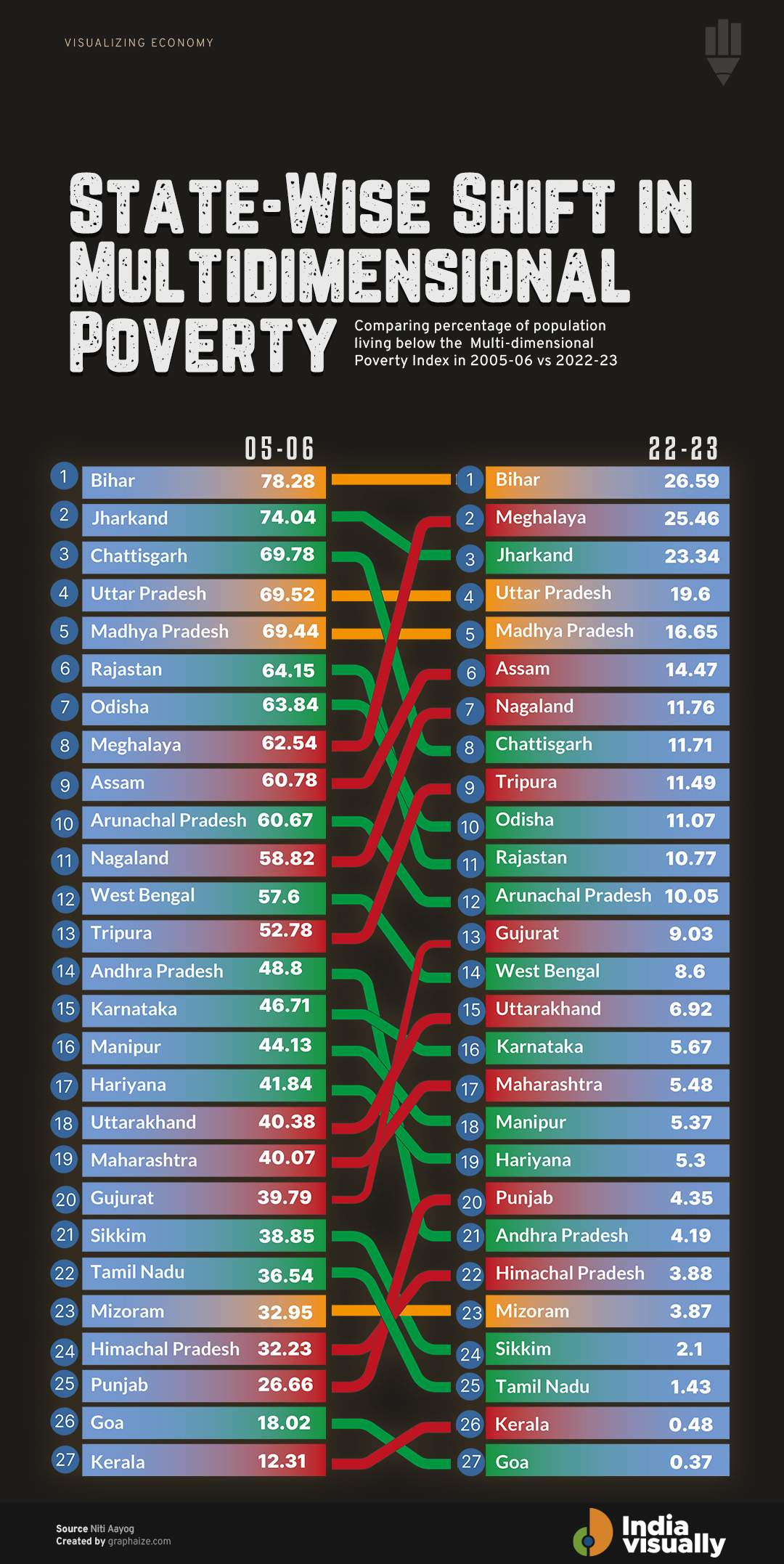
Multidimensional poverty in India has been declining at a historic pace, reshaping the lives of millions across states. While income matters, poverty is much more than low earnings—it’s about access to healthcare, education, housing, sanitation, nutrition, and the opportunity to live with dignity. That’s exactly why a state wise multidimensional poverty analysis becomes crucial. It helps us understand where deprivation is falling fast, where progress is slower, and why some states have outperformed others.
In this detailed breakdown, we explore how India’s states have shifted across key MPI indicators, what the latest numbers reveal, and which states are driving India’s remarkable transformation.
What Multidimensional Poverty Really Means
Multidimensional poverty looks beyond money and examines what people experience daily—whether they have safe housing, clean water, enough food, schooling, healthcare, and basic household assets. India’s Multidimensional Poverty Index (MPI) uses 3 broad dimensions:
Health: nutrition, child mortality
Education: years of schooling, school attendance
Standard of Living: housing, sanitation, drinking water, electricity, cooking fuel, assets
Tracking these indicators helps the government understand not just how many people are poor, but how they are poor—and what needs to change.
Recent nationwide surveys show a major decline in India’s MPI across almost every state. But this progress isn’t uniform. Some states show extraordinary improvement, while others still face deep-rooted challenges.
Why a State Wise Multidimensional Poverty Analysis Matters
India is incredibly diverse, and a single national poverty figure cannot capture the wide differences in how people live across states. This is exactly why a detailed state wise multidimensional poverty analysis becomes so important. Each state has its own population size, resource availability, development priorities, and administrative capabilities, which naturally lead to very different outcomes.
Some states have consistently invested in health, education, and social welfare systems, while others are still catching up due to geographic, economic, or historical challenges. Even within the same state, rural and urban regions often experience poverty very differently—rural areas may struggle with access to schools and healthcare, while urban clusters deal with overcrowding, migration pressures, and unaffordable housing.
For policymakers, these differences are crucial. State-level insights help identify where interventions are needed the most, where progress is strong, and where strategies must be redesigned. In the bigger picture, understanding these variations allows us to see not just how India is improving overall, but how each state contributes uniquely to the country’s broader poverty reduction journey.
Major & Moderate Reductions in Multidimensional Poverty
| State | Previous MPI / Headcount Ratio | Current MPI / Headcount Ratio | Key Improvements |
|---|---|---|---|
| Bihar | Above 70% | Significantly lower | Big gains in schooling, sanitation, housing, electricity |
| Uttar Pradesh | ~60% | Much lower | Better roads, electricity, toilets, Anganwadi coverage |
| Madhya Pradesh | ~60% | ~41% | More healthcare access, schooling, clean fuel, electricity |
| Rajasthan | High earlier levels | Strong decline | Electrification, maternal-child healthcare, welfare schemes |
| Odisha | 63% | ~34% | National model of rural poverty reduction |
| West Bengal | ~41% | ~25% | Better welfare delivery, schooling, housing |
| Jharkhand | 74% | 37% | Big gains in sanitation, nutrition, electrification |
| Chhattisgarh | ~60% | 35% | Better food security, healthcare, rural livelihoods |
States With Slower Progress or Rising Concerns
While many states have made strong gains in reducing multidimensional poverty, a few regions continue to show slower progress compared to their neighbors. Mizoram, for example, still records poverty levels above 32%. Although the state has improved over time, the pace remains modest due to its challenging terrain and limited access to large-scale infrastructure. Manipur’s poverty reduction also sits around 20%, influenced by instability, uneven development, and persistent infrastructure gaps that affect the delivery of essential services.
Punjab and Himachal Pradesh present a different picture. Their overall MPI levels were already low, which naturally limits the scope for large numerical declines. However, this doesn’t mean poverty has been eliminated. Both states still contain localized pockets of deprivation, especially in rural belts and among marginalized communities. These states now require highly targeted welfare programs rather than broad-based interventions to address the remaining clusters of poverty effectively.
Key Drivers Behind India’s Poverty Reduction
| Driver | Description |
|---|---|
| Housing and Basic Amenities | National schemes such as PMAY, Swachh Bharat, Jal Jeevan Mission, and Saubhagya have upgraded rural living standards by improving access to secure housing, sanitation, clean water and reliable electricity. |
| Healthcare Improvements | Strengthened maternal and child healthcare, broader vaccination campaigns, and an expanded network of primary health centres have reduced avoidable deprivation and improved survival and nutrition outcomes. |
| Education Growth | Better school attendance, improved mid-day meal programmes and increased access to digital learning have strengthened foundational skills and raised future earning potential. |
| Women’s Empowerment | Greater involvement in self-help groups (SHGs), improved access to microfinance, and targeted welfare schemes have boosted women’s financial security and household resilience. |
| Direct Benefit Transfers (DBT) | Digital delivery of subsidies and cash transfers ensures benefits reach the right people quickly, cutting leakages and improving the efficiency of welfare programmes. |
Urban vs Rural Poverty Shifts Across States
A detailed state wise multidimensional poverty analysis reveals clear contrasts between rural and urban areas across India. Rural regions have experienced faster improvement, especially in states like Uttar Pradesh, Bihar, Madhya Pradesh, and Odisha. This progress is closely linked to large-scale rural electrification, widespread sanitation coverage, and the expansion of basic amenities that directly improved everyday living conditions. Agricultural growth, increased rural employment opportunities, and better connectivity have also contributed to rising living standards in many villages.
Urban areas, on the other hand, show a more uneven pattern. While poverty has declined, the improvement is slower in states with high levels of migration, where cities struggle to absorb large populations. Urban slums continue to face challenges such as insecure housing, inadequate sanitation, and limited access to quality healthcare. Additionally, rising living costs—especially rent, transportation, and food—place extra pressure on low-income families, often offsetting the benefits of better job opportunities.
Understanding how these two segments move in different directions is essential for policymakers. It ensures that state-level strategies address both the unique challenges of urban poverty and the opportunities for continued growth in rural areas.
Conclusion
India’s poverty story is undergoing a dramatic transformation. A detailed state wise multidimensional poverty analysis reveals that while the country as a whole is moving forward, each state has taken a unique path. Some states—like Bihar, UP, MP, Odisha, and Rajasthan—have achieved remarkable reductions. Southern states maintain low poverty levels with efficient welfare systems. The Northeast shows varied results, while a few states still need targeted support.
Overall, India has made historic progress, but the journey isn’t over. Sustained investment, smart policies, and inclusive development will be key to ensuring every Indian household experiences the benefits of growth.
Unlock the power of captivating visuals with our seasoned expertise! With 7 years of crafting compelling visual content, we’re ready to elevate your brand’s story. From stunning graphics to mesmerizing animations, we bring your vision to life. Let’s create engaging visuals that resonate with your audience and leave a lasting impression. Partner with us today for an unforgettable visual journey!