
Manual scavenging is one of the harshest and most dangerous forms of work still happening in India today. It involves cleaning sewers, septic tanks, and manholes by hand—tasks that expose workers to toxic gases, suffocation, infections, and fatal accidents. Even though manual scavenging has been officially banned, the ground reality tells another story.
Manual scavenging deaths in India continue to occur every year, highlighting not just administrative failure but also a deep-rooted social injustice. Reports from the National Crime Records Bureau (NCRB), independent government surveys, and multiple news investigations reveal that many sanitation workers still enter sewers without protective gear or modern equipment.
Despite legal bans, strict guidelines, and public pressure, the system continues to fail the very people who keep our cities running. And unfortunately, most of the deaths are preventable.
India’s Manual Scavenging Problem — A Reality Check (Manual Scavenging Deaths in India)
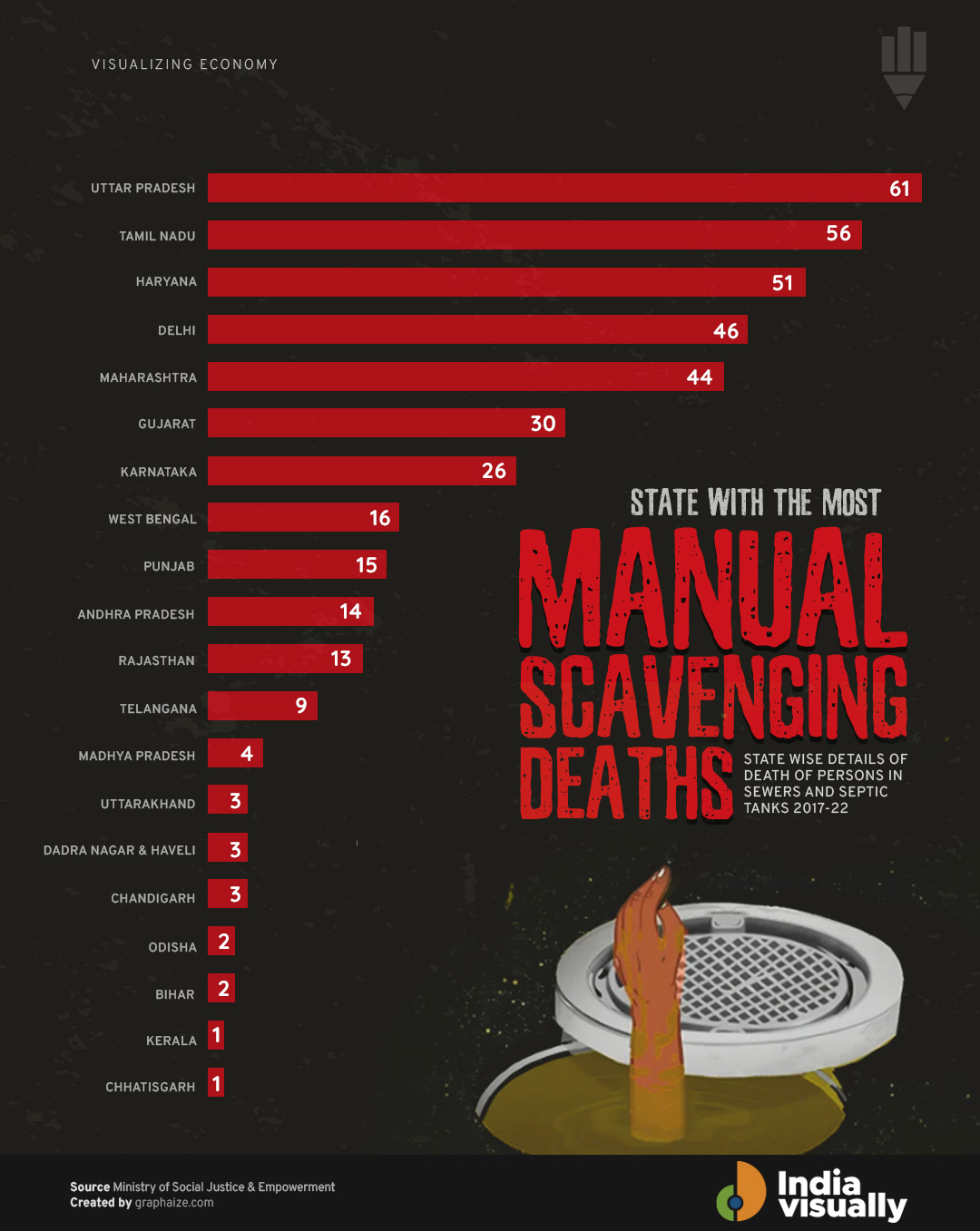
When we talk about manual scavenging deaths in India, we’re not just looking at statistics—we’re looking at real workers who lost their lives inside toxic sewers, collapsed manholes, and hazardous septic tanks. The data clearly shows how widespread and deadly this crisis remains. Most of these workers come from marginalised communities, pushed into dangerous sanitation jobs due to poverty, limited opportunities, and caste-based occupational patterns. Urban regions show higher fatalities because cities depend heavily on underground sewer systems and contract labour, while rural areas still see deaths during septic tank cleaning.
Below is the state-wise distribution of deaths, based on the numbers you provided:
| State / UT | Deaths |
|---|---|
| Uttar Pradesh | 61 |
| Tamil Nadu | 56 |
| Haryana | 51 |
| Delhi | 46 |
| Maharashtra | 44 |
| Gujarat | 30 |
| Karnataka | 26 |
| West Bengal | 16 |
| State / UT | Deaths |
|---|---|
| Punjab | 15 |
| Andhra Pradesh | 14 |
| Rajasthan | 13 |
| Telangana | 9 |
| Madhya Pradesh | 4 |
| Uttarakhand | 3 |
| Dadra & Nagar Haveli | 3 |
| Chandigarh | 3 |
| Odisha | 2 |
| Bihar | 2 |
| Kerala | 1 |
| Chhattisgarh | 1 |
Understanding Why These States Have the Highest Numbers
It’s important to understand why these states consistently report the highest manual scavenging deaths. Most of them have large urban populations and extensive underground drainage systems that require frequent maintenance. They rely heavily on contract-based sanitation workers instead of trained permanent staff, and safety laws are often poorly enforced. Mechanisation is limited, so workers are still sent into dangerous chambers by hand. Social and economic vulnerability also pushes many individuals to accept these risky jobs despite the dangers. Because sewer cleaning is often outsourced to private contractors, safety rules are ignored to cut costs, leading workers to enter toxic spaces without masks, gloves, boots, or oxygen support — conditions that can become fatal within seconds.
Case Studies from High-Death States
Several incidents across UP, Tamil Nadu, Haryana, and Delhi reveal the same pattern: unsafe working conditions and zero safety compliance.
Families often report that their loved ones were called in late at night, offered low pay, and asked to enter a toxic sewer without any gear. Municipal corporations frequently outsource the cleaning work to private operators who cut costs by skipping safety equipment.
Cities like Chennai, Lucknow, Gurugram, and Delhi have reported multiple cases where more than one worker died in the same sewer line, often because the first worker collapsed and others entered the chamber to rescue them—only to meet the same fate.
This is not just a safety issue—it’s a systemic failure.
The Role of Private Contractors and the Push for Safer Technology
A large share of manual scavenging deaths in India happens under private contractors, who often send workers into toxic sewer lines without any protective gear or training. Many workers are paid in cash and kept unregistered, making them untraceable and leaving their families without support when accidents occur. Contractors commonly deny responsibility by claiming workers were not officially employed, while municipalities use outsourcing to avoid direct accountability.
At the same time, India already has technology that can replace manual sewer cleaning — from robotic machines to high-pressure jets and vacuum suction trucks. Cities like Kerala, Mumbai, and Hyderabad have shown that these tools can save lives. Yet adoption remains slow because machines are costly, workers aren’t trained to use them, and local bodies still rely on cheap manual labour. Without proper investment and enforcement, technology cannot make the impact it should.
Conclusion — Ending a Centuries-Old Injustice
The data makes one thing painfully clear: manual scavenging deaths in India are not accidents—they are preventable tragedies caused by negligence, inequality, and weak enforcement. Workers who enter sewer lines do so because they have no other choice, no protection, and no support.
Ending manual scavenging is not just about banning it—it’s about restoring dignity, ensuring safety, and replacing dangerous work with machines and trained professionals. Every life lost inside a sewer is a national failure, and it’s time we treat it with the urgency and humanity it deserves.
A country moving toward digital futures, AI, and smart cities shouldn’t still lose people to toxic sewer fumes. With the right laws, technology, and compassion, India can end this injustice once and for all.
Unlock the power of captivating visuals with our seasoned expertise! With 7 years of crafting compelling visual content, we’re ready to elevate your brand’s story. From stunning graphics to mesmerizing animations, we bring your vision to life. Let’s create engaging visuals that resonate with your audience and leave a lasting impression. Partner with us today for an unforgettable visual journey!