
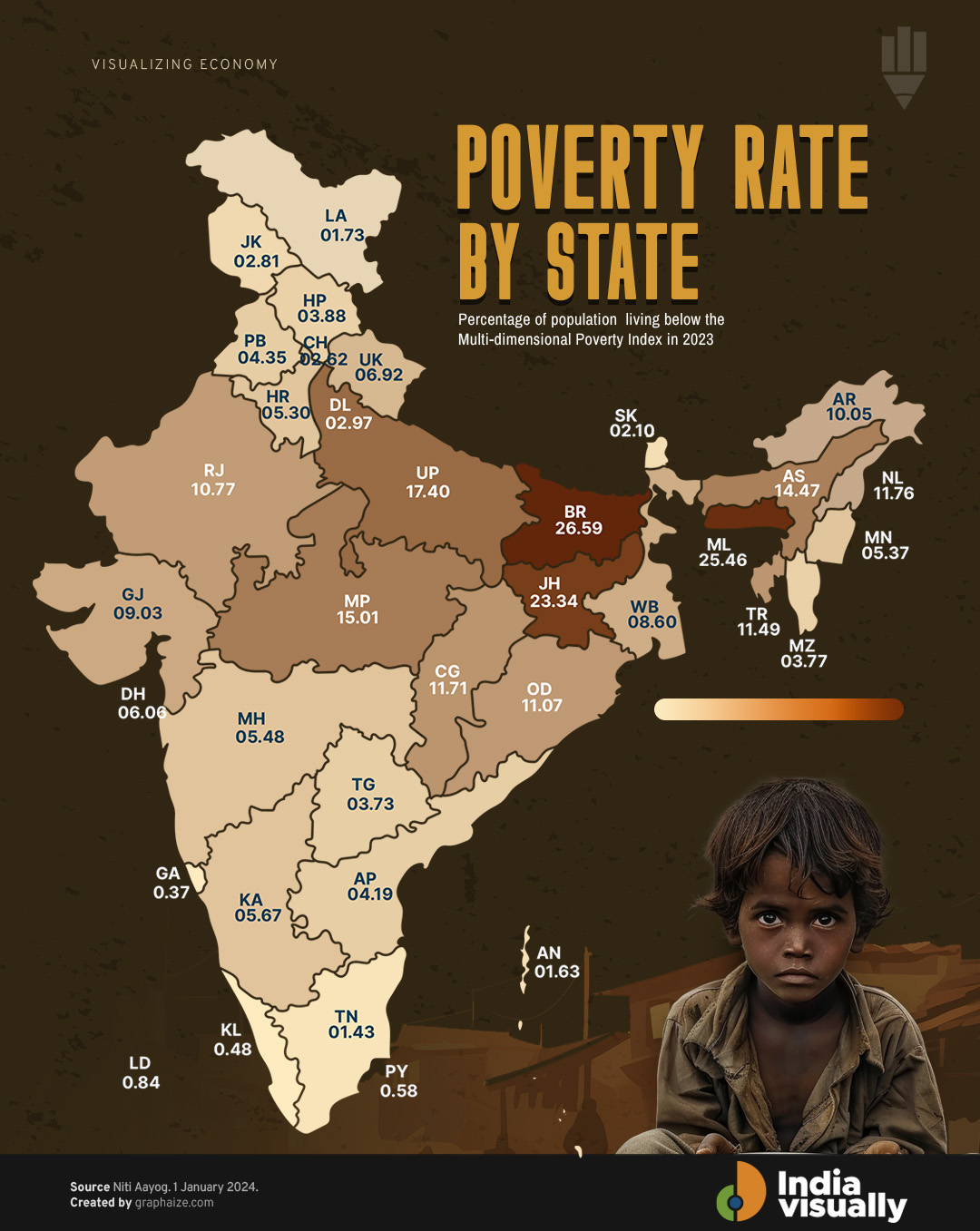
Poverty has long been one of India’s most pressing challenges — but it doesn’t affect every state equally. While some regions have made remarkable progress in reducing deprivation, others continue to struggle with low income, unemployment, and limited access to basic needs. By studying state-wise poverty rates, we get a clearer picture of how wealth and welfare are distributed across the country — and where the efforts to uplift people are still falling short.
Understanding state-wise poverty rates isn’t just about numbers; it’s about uncovering patterns that define India’s social and economic landscape. It tells us where growth has been inclusive and where it has left communities behind. This information plays a crucial role in policymaking, welfare allocation, and long-term sustainable development.
What Are State-Wise Poverty Rates?
When we talk about state-wise poverty rates, we’re essentially looking at the percentage of people in each state living below the poverty line. These rates are calculated using a mix of economic and social indicators — including income, consumption expenditure, and access to basic necessities like housing, healthcare, and education.
They help policymakers and researchers identify which regions require stronger government support and targeted interventions. For instance, states like Bihar and Jharkhand have historically recorded higher poverty ratios compared to states like Kerala or Goa, where the quality of life and income levels are much better.
By analyzing these differences, governments can create strategies tailored to the unique challenges of each region — rather than applying a one-size-fits-all solution.
How Poverty Is Measured in India
Poverty in India has evolved in definition over the decades. Traditionally, it was measured using income or consumption levels — specifically how much an individual or household spends on basic necessities such as food, clothing, and shelter. Committees like the Tendulkar Committee (2009) and the Rangarajan Committee (2014) have refined these measurements to reflect changing living standards.
In recent years, India has shifted to a more comprehensive measure — the Multidimensional Poverty Index (MPI) by NITI Aayog. Unlike older methods, the MPI goes beyond income. It considers three major dimensions:
- Health (nutrition, child mortality, access to healthcare)
- Education (years of schooling, school attendance)
- Standard of Living (electricity, sanitation, drinking water, housing, and assets)
This holistic approach offers a clearer view of deprivation. For example, even if someone earns enough to survive, lack of access to clean water or education may still categorize them as poor in the multidimensional sense.
Top 10 Poorest States in India (2025 Data Overview)
According to the latest estimates, poverty remains deeply concentrated in a few states. Based on state-wise poverty rates, the following are among the poorest in India:| Rank | State | Poverty Rate (2025) | Key Challenges |
|---|---|---|---|
| 1 | Bihar | 26.59% | High population density, poor infrastructure, low literacy |
| 2 | Jharkhand | 23.34% | Rural unemployment, tribal underdevelopment, limited industry |
| 3 | Chhattisgarh | 11.07% | Agricultural dependence, low education access, tribal poverty |
| 4 | Madhya Pradesh | 11.61% | Slow industrial growth, uneven rural development |
| 5 | Uttar Pradesh | 17.40% | Overpopulation, weak healthcare, rural job scarcity |
| 6 | Assam | 14.47% | Flood-prone regions, low industrial activity |
| 7 | Odisha | 11.07% | Tribal poverty, weak education outcomes, rural isolation |
| 8 | Nagaland | 11.76% | Remote terrain, low job opportunities, limited industries |
| 9 | Manipur | 5.37% | Political instability, weak connectivity, limited investment |
| 10 | West Bengal | 8.06% | High rural population, slow industrial revival |
The Richest States with the Lowest Poverty Rates
On the other end of the spectrum, several Indian states have made remarkable progress in reducing poverty. States like Kerala, Goa, Tamil Nadu, and Himachal Pradesh consistently record the lowest state-wise poverty rates in the country.
- Kerala (0.19%) stands out as a model of human development, thanks to its high literacy rate, efficient healthcare, and strong social welfare systems.
- Goa (0.37%) benefits from tourism, high per capita income, and a service-oriented economy.
- Tamil Nadu (0.14%) has leveraged industrialization and social reforms to uplift its population.
- Himachal Pradesh (0.83%) shows how even a hilly state can succeed through investments in education and local entrepreneurship.
These states prove that poverty is not an inevitable outcome of geography or population size — it’s a reflection of governance quality, infrastructure, and the inclusiveness of growth.
Rural vs. Urban Poverty in India
Poverty in India has two very different faces — rural and urban.
In rural areas, poverty is largely shaped by limited employment opportunities, dependence on agriculture, and poor access to healthcare and education. Many families lack basic amenities like electricity, toilets, and safe drinking water.
Urban poverty, on the other hand, is hidden in plain sight. Cities attract migrants seeking jobs and better lives, but many end up living in slums with unstable incomes and poor living conditions. Informal labor dominates urban poor communities, leaving them vulnerable to inflation and job insecurity.
Interestingly, while urban areas offer more economic opportunities, the cost of living often cancels out the advantage — keeping many low-income families below the poverty threshold.
Key Factors Behind State-Wise Poverty Differences
Why does poverty vary so much from one Indian state to another? Several interlinked factors contribute to this gap:| Key Factor | Description |
|---|---|
| Industrialization and Economic Growth | States with diverse industries, like Maharashtra and Gujarat, offer more stable jobs and higher wages. |
| Quality of Education and Skill Development | Education empowers people to move beyond low-paying labor. |
| Access to Healthcare and Infrastructure | Better health services and roads directly impact productivity and income. |
| Governance and Policy Implementation | States with transparent and efficient governance tend to use welfare funds more effectively. |
| Natural Resource Distribution | Resource-rich states may still remain poor if governance is weak and industries are underdeveloped. |
Trends and Changes in State-Wise Poverty Rates Over Time
India’s poverty story has seen remarkable transformation over the past few decades. In the early 2000s, nearly half the population lived below the poverty line. Today, that number has dropped dramatically.
Southern and western states — such as Kerala, Maharashtra, and Gujarat — have seen the fastest reduction in poverty due to stronger infrastructure, education, and urbanization. In contrast, northern and eastern states like Bihar and Uttar Pradesh have lagged, partly due to slower industrialization and governance issues.
Post-pandemic data shows a temporary rise in poverty levels due to job losses and inflation, but recovery is already visible. States with diverse economies and digital governance have bounced back faster than those relying heavily on agriculture.
The Link Between Education, Employment, and Poverty
One of the strongest influences on state-wise poverty rates is the connection between education and employment. States that invest heavily in education tend to see faster poverty reduction. Kerala is the perfect example — its high literacy rate and strong focus on education directly correlate with its remarkably low poverty levels.
In contrast, states that struggle with low school attendance, limited access to higher education, and poor vocational infrastructure often face persistent income inequality. Without the right skills or qualifications, large segments of the population remain stuck in low-paying, unstable jobs.
Investing in vocational training, digital literacy, and entrepreneurship programs can bridge this gap. When young people and women gain employable skills, they can move into better-paying roles, reducing their long-term dependence on government aid and creating a stronger, more resilient workforce.
However, even with this progress, India faces multiple challenges in ensuring uniform poverty reduction across all regions. Regional inequality remains a concern — while some states are racing ahead with development, others are still struggling to catch up. Migration and urban pressure are adding new layers of complexity, as rural-urban migration fuels overcrowding and unstable employment in cities.
Moreover, underemployment — where people have jobs but earn too little to live decently — continues to limit progress. And with inflation and economic shocks affecting household budgets, even small disruptions can push families back below the poverty line.
To truly overcome these hurdles, India needs state-specific poverty strategies, stronger coordination between central and local governments, and consistent monitoring to ensure that economic growth benefits everyone. Only then can education and employment work hand in hand to close the poverty gap and pave the way toward a more inclusive India.
Conclusion — Towards an Inclusive India
The story told by state-wise poverty rates is one of both progress and disparity. India has made significant strides in lifting millions out of poverty, but the journey isn’t over yet.
Some states are glowing examples of how education, governance, and social investment can transform lives. Others remind us that inequality remains a deep-rooted issue that requires long-term commitment.
Understanding these differences is the first step toward creating targeted, effective solutions. With continued focus on education, employment, and empowerment, India can move closer to a future where prosperity truly reaches every state — and every citizen.
Unlock the power of captivating visuals with our seasoned expertise! With 7 years of crafting compelling visual content, we’re ready to elevate your brand’s story. From stunning graphics to mesmerizing animations, we bring your vision to life. Let’s create engaging visuals that resonate with your audience and leave a lasting impression. Partner with us today for an unforgettable visual journey!