

The Compounding Effect of Branding: What It Actually Means
Let’s define this clearly before going further, because the word “compounding” gets used loosely in marketing without much explanation of the actual mechanism behind it.
In finance, compounding means your returns start earning their own returns, so growth accelerates instead of staying flat. The compounding effect of branding works the same way, structurally. Each new piece of consistent visual content doesn’t just add its own individual impact. It builds on the recognition, trust, and audience already established by everything posted before it. Post ten, twenty, or fifty doesn’t start from zero, it starts from wherever the previous content left off, and that starting point keeps climbing.

Compare this to a brand that posts inconsistently, sometimes daily, then nothing for two months, then a burst of activity, then silence again. Each new post there is essentially reintroducing the brand to an audience that barely remembers the last one. There’s no accumulation happening. That’s the fundamental difference between linear effort and compounding growth, and it’s why two brands with identical output totals can end up in completely different places a year later.
It helps to put actual numbers on this distinction. Imagine two brands each publish 100 pieces of visual content over a year. Brand A posts roughly two per week, every week, without exception. Brand B posts in unpredictable bursts, twenty pieces in an enthusiastic January, then almost nothing until a scramble to catch up in July, then another gap. Both hit the same total. But Brand A’s audience has spent an entire year gradually forming a stable mental picture of who this brand is. Brand B’s audience has experienced the brand in disconnected fragments, never quite given enough consistent exposure to form that same stable picture. Same output, structurally different result, and that structural difference is entirely explained by the mechanisms this article walks through next.
Why Recognition Requires Repetition, Not Just Exposure
Human memory doesn’t work the way marketers sometimes wish it did. Brand recognition builds through repetition, and repetition requires consistency. The brain doesn’t file away a brand as familiar after a single exposure. It takes multiple sightings of the same colors, the same visual style, the same format, before something crosses the threshold from “I’ve seen this somewhere” to “I know this brand.”

This is why major brands obsess over visual consistency down to exact hex codes and font choices. It’s not aesthetic perfectionism, it’s a deliberate strategy to make every single piece of content contribute to the same growing mental file in a viewer’s head, rather than each post existing as an isolated, disconnected impression.
This is why brands with genuinely recognizable social presences almost always share one trait: a consistent mascot, color palette, or tone that shows up in the same recognizable way, post after post, for years. No single post makes that identity famous. The accumulated weight of hundreds of consistent posts does, each one reinforcing a visual and tonal identity viewers already half recognized before they’d finished watching.
This same principle explains why rebranding, however well intentioned, is genuinely risky from a compounding standpoint. Every established visual cue a brand has built, a specific color, a mascot, a signature format, represents accumulated recognition capital. Changing it doesn’t just refresh the look, it partially resets the very mechanism that made years of consistent posting valuable in the first place. That doesn’t mean brands should never evolve visually, but it does mean the decision deserves more weight than “we’re bored of the old look.”
How Inconsistency Resets the Compounding Effect of Branding
Here’s the part that trips up a lot of otherwise well intentioned content teams. Inconsistent posting resets that recognition process with every new piece of content, while consistent posting lets each new piece build on the recognition already established.
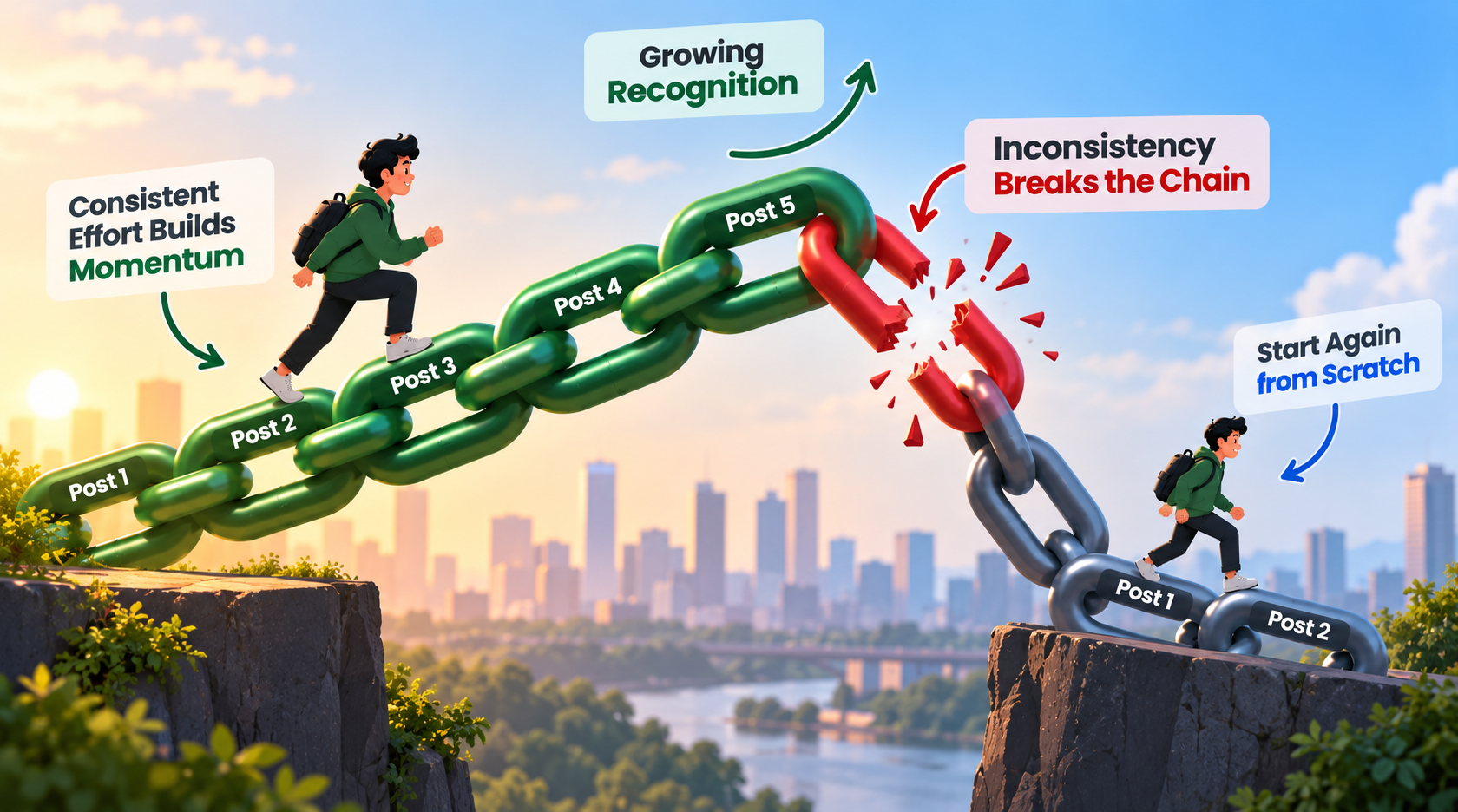
Think about what happens practically inside a viewer’s mind when a brand disappears for two months and then reappears. The visual style might have drifted slightly. The tone might feel a bit different. And critically, the viewer’s memory of the brand has already started to fade, so the new content is doing double duty: it has to reestablish familiarity before it can build on anything.
This is precisely why the compounding effect of branding breaks down under inconsistent posting schedules, even when the actual content quality stays high. Compounding requires an unbroken chain. Break the chain, and you’re not slowing the growth curve down, you’re resetting it back toward the starting line each time.
A few concrete symptoms of a broken compounding chain:
- Engagement rates that spike briefly after a comeback post, then flatten out again just as quickly
- An audience that has to be “reintroduced” to the brand’s visual style every few months
- Content performance that never seems to build momentum, each post performs roughly the same regardless of how long the brand has existed
Why Trust in Serious Categories Builds Slowly, Not Instantly
Recognition is only half the story. The other half is trust, and trust compounds even more slowly than recognition does, especially in categories where the stakes feel high to the viewer.
Trust in serious categories like finance or healthcare is earned slowly, not instantly. No single video convinces a skeptical viewer that a brand knows what it’s talking about. But the fifth, tenth, or twentieth genuinely helpful post gradually builds a different kind of impression: this brand consistently shows up with something useful, which suggests they actually know their subject rather than just performing expertise for one viral moment.
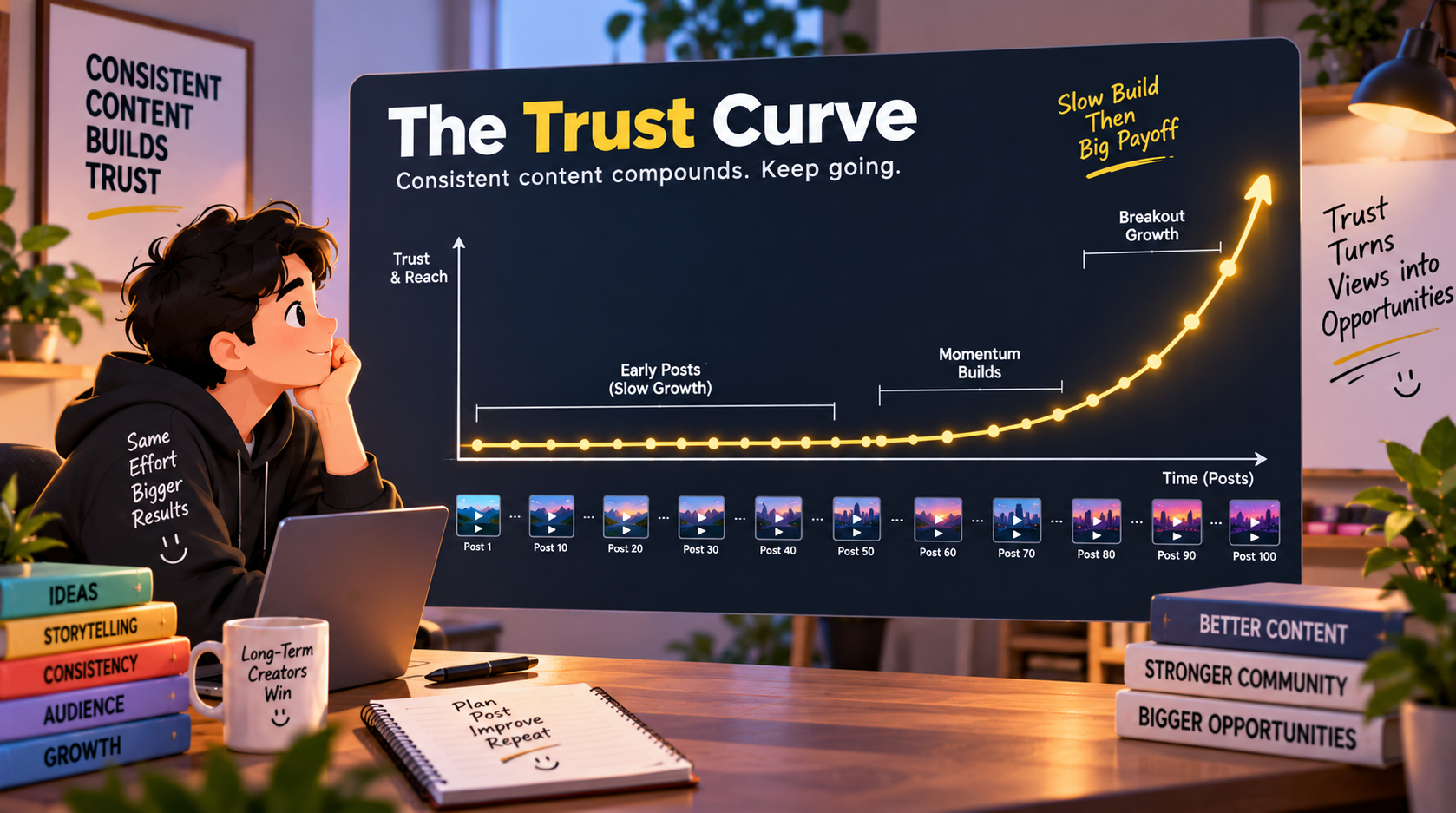
This is the exact mechanism behind why educational content creators in serious niches, financial explainers, medical professionals, legal experts, tend to see slow initial growth followed by a much steeper trust curve later on. Their tenth video doesn’t perform ten times better than their first purely because the algorithm favors them more. It performs better because an accumulated audience already believes them, and that belief didn’t exist yet when the channel started.
This slowbuild pattern frustrates a lot of teams in their first few months, and it’s worth naming why. Early metrics almost always understate the real trajectory of a consistent, trustbuilding content strategy. A brand’s fifth video might get modest views and even a few skeptical comments questioning credibility. That same brand’s fiftieth video, covering a similar topic with similar production quality, often performs dramatically better, not because the content itself improved that much, but because the accumulated trust from the previous fortynine posts is now doing real work in the background. Teams that give up during that slow early stretch never get to see the curve bend upward.
The Snowball Effect: Old Content That Keeps Working
This next mechanism gets overlooked constantly, and it might be the most underrated part of the entire compounding equation.

Old content doesn’t disappear after it’s published. It continues to be found through search, shares, and recommendations long after the fact. A wellmade explainer video posted eighteen months ago can still quietly bring in new viewers today, through search results, suggested video feeds, or someone sharing a link in a group chat. That video is still working, even though nobody on the team is actively promoting it anymore.
A brand that has posted consistently for a year has a growing backlog of old content quietly generating views and trust every single day, on top of whatever new content is published that week. Think of this as two separate streams running simultaneously: the active stream (this week’s new post) and the passive stream (every past post still slowly accumulating views). A consistent brand’s passive stream grows continuously wider over time. Inconsistent brands don’t build this background layer of ongoing, passive discovery, because there simply isn’t enough accumulated content sitting in the archive to generate meaningful passive traffic.
This is one of the clearest, most measurable forms of compounding in the entire content strategy: a channel with 200 pieces of evergreen content genuinely gets discovered more often than a channel with 20, even if the newer content posted this month is identical in quality between the two.
There’s a compounding within compounding effect here too, worth flagging. As a brand’s archive grows, that archive itself becomes a stronger signal of authority to both viewers and platform algorithms. A viewer landing on a channel with two years of consistent, organized content behind it forms a very different impression than one landing on a channel with three scattered uploads, even before watching a single video. That immediate credibility, built entirely by the size and consistency of the archive itself, is a compounding advantage that’s essentially impossible for a newer or inconsistent brand to shortcut around. It has to be earned through time.
How Your Existing Audience Makes Future Content Perform Better
The final mechanism ties everything together, and it’s the part that actually creates the feedback loop that makes compounding accelerate rather than just accumulate steadily.
An existing audience makes future content perform better. Someone who has already watched and liked several posts is far more likely to engage with the next one than a complete stranger would be. This isn’t just a nice side effect, it’s structurally important, because engagement is exactly what triggers the algorithmic amplification discussed earlier.
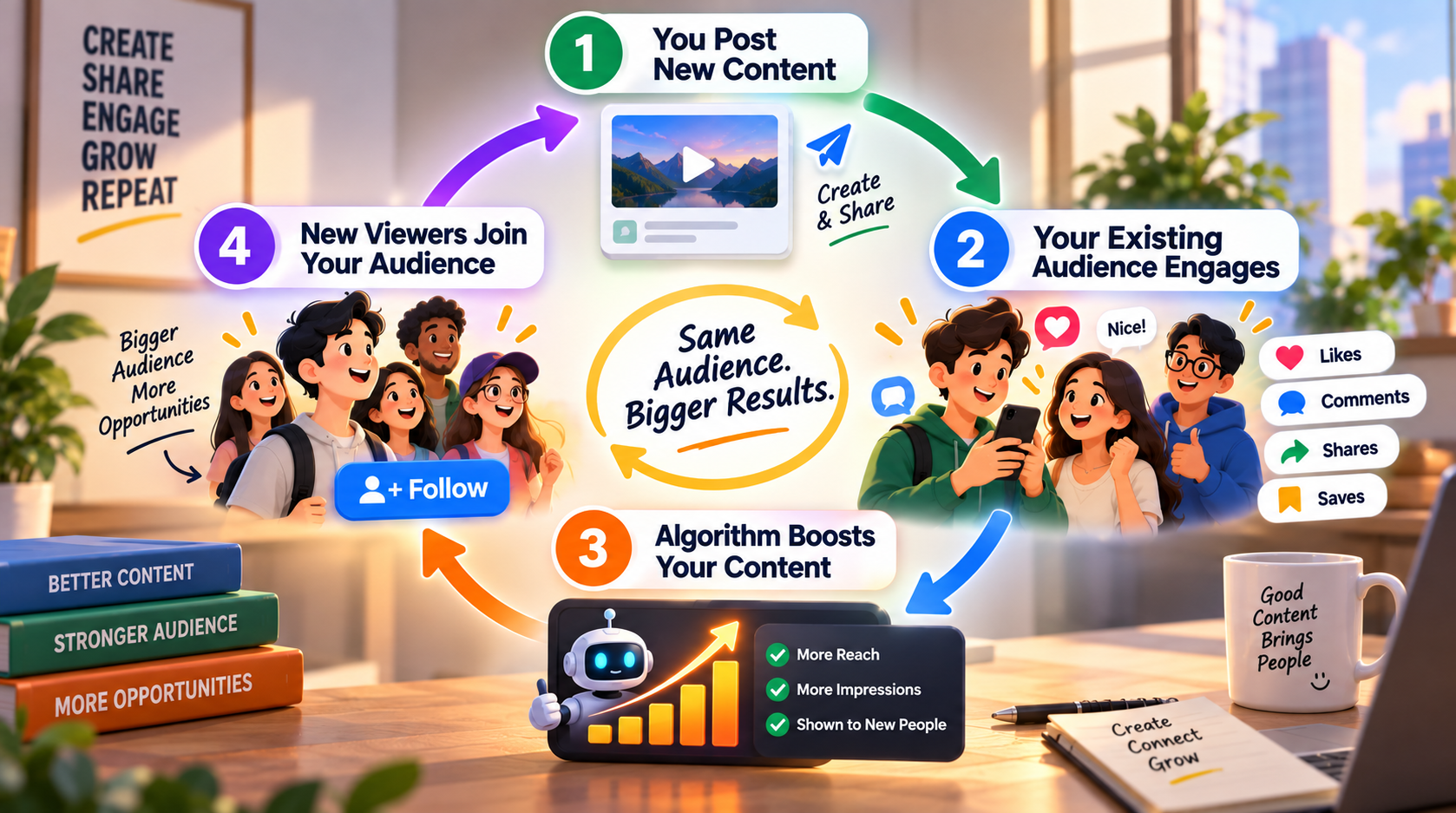
Here’s how the full loop actually connects:
- Consistent posting builds a small but growing base audience
- That base audience engages faster and more reliably with each new post
- Fast, strong early engagement signals to the platform’s algorithm that the content is worth showing more broadly
- Wider distribution brings in new viewers, some of whom become part of the base audience
- The larger base audience makes the next post perform even better than the one before it
That audience engagement creates a feedback loop: more engagement signals to the algorithm that the content is worth showing to more people, which brings in new viewers who then become part of the next loop. This is the actual engine behind acceleration, not just accumulation. Each cycle through this loop makes the next cycle start from a stronger position, which is exactly what separates true compounding growth from simple linear addition.
It’s worth stepping back and seeing how all these individual mechanisms interlock, because none of them work in isolation:
- Recognition builds through repeated visual exposure, requiring consistency to accumulate rather than reset
- Trust builds slowly through repeated demonstrations of expertise, especially in serious categories
- Algorithmic reach rewards consistent posting behavior with amplified distribution
- Passive discovery grows continuously as an archive of old content keeps working in the background
- Audience engagement creates a feedback loop that accelerates future content’s performance
Recognition, trust, algorithmic reach, and audience engagement all build on top of each other rather than resetting with each new post, which is what makes the growth compound instead of simply add up over time. None of these five mechanisms is powerful enough alone to explain the dramatic difference between consistent and inconsistent brands. Together, stacked on top of each other, they explain it completely.

How to Build a Consistent Visual Content System
Understanding the mechanism is one thing, building a system that actually sustains it is another. A few practical principles help:
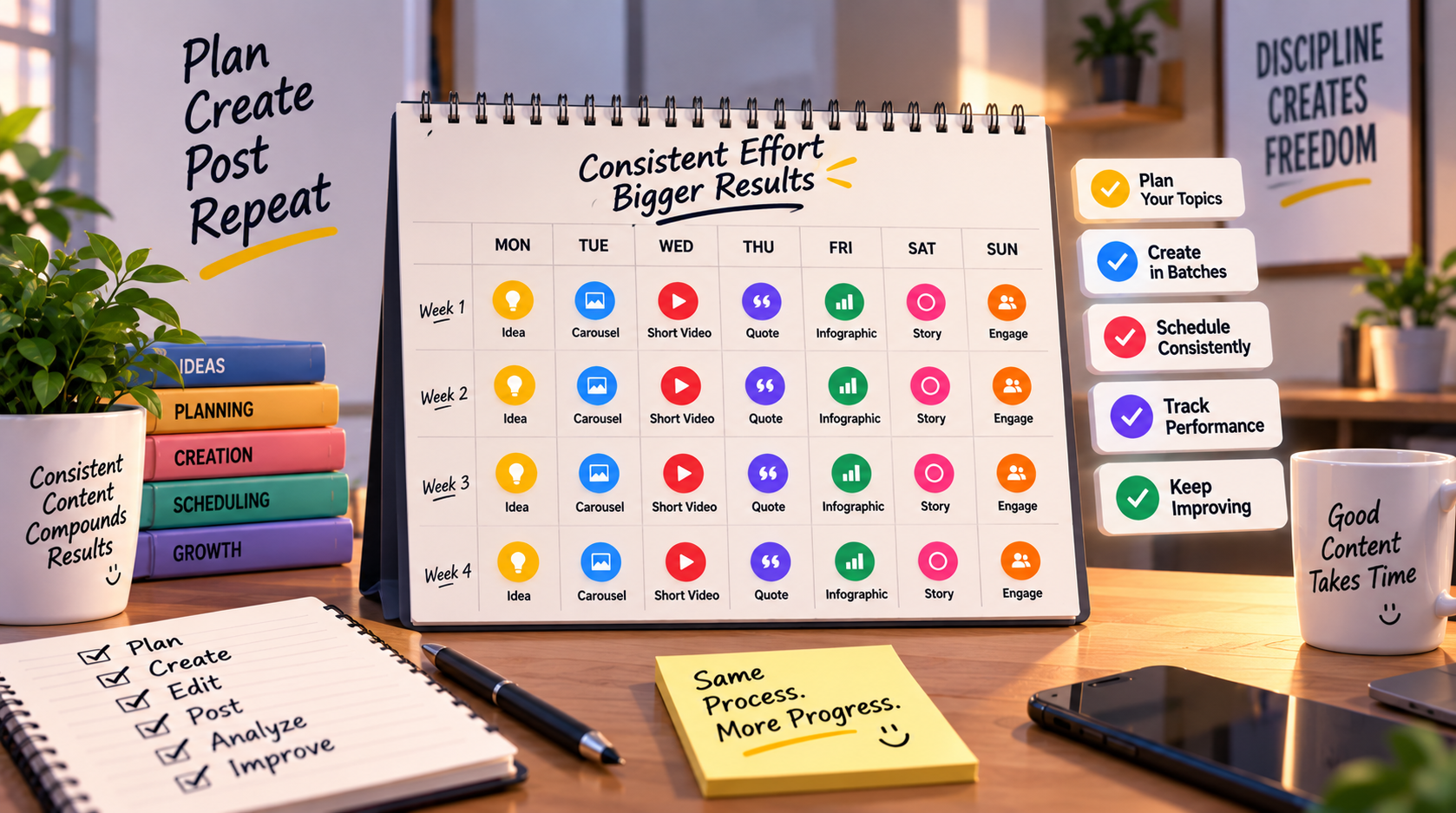
- Pick a visual identity you can maintain, not just one you love. Consistency requires a style your team can realistically reproduce every week, not a one off masterpiece that’s exhausting to replicate.
- Set a realistic posting rhythm and protect it. A modest, sustainable schedule maintained for two years beats an ambitious schedule abandoned after two months, every time, because of exactly the reset effect described earlier.
- Treat old content as an asset, not a finished task. Update titles, descriptions, and thumbnails on older posts periodically to keep them discoverable, since they’re still part of your passive traffic engine.
- Track engagement trends over months, not single posts. A single underperforming post means very little. A downward trend across several months signals the compounding loop is stalling and needs attention.
- Use recurring visual formats. A consistent explainer video style, the same intro animation, the same color palette, the same narration tone, does more for long term recognition than constantly reinventing your visual approach from scratch each time.