
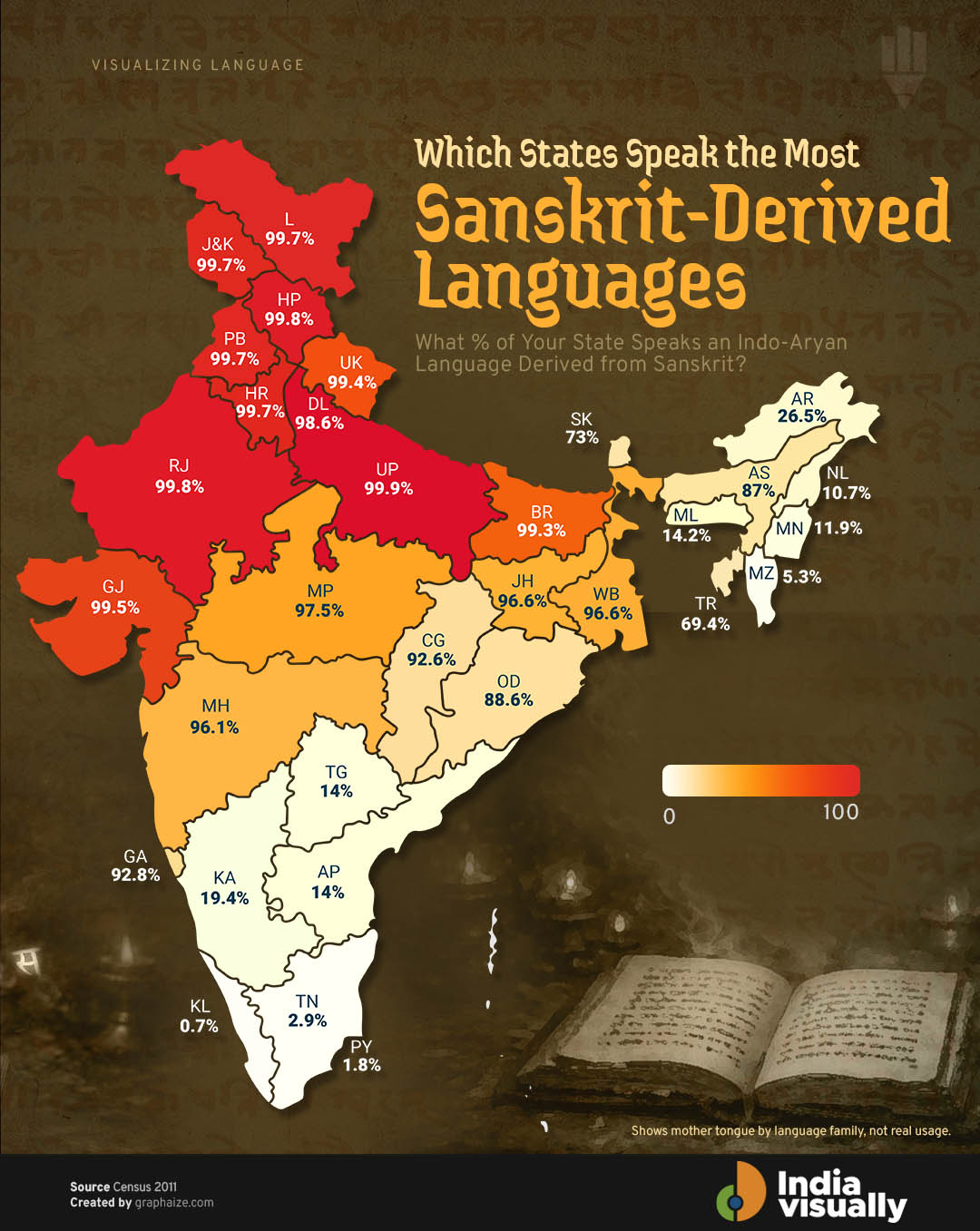
India is home to one of the richest linguistic traditions in the world. With hundreds of languages spoken across different regions, the country’s diversity is truly remarkable. Among these languages, many belong to the Indo Aryan family, which evolved from ancient Sanskrit. This raises an interesting question: which Indian state speaks the most Sanskrit-derived language?
Understanding sanskrit by state not only reveals linguistic patterns but also helps us see how history, migration, and culture have shaped communication across India. While Sanskrit itself is rarely spoken conversationally today, its influence remains deeply embedded in several modern languages like Hindi, Marathi, Bengali, and Gujarati.
In this article, we explore how Sanskrit has shaped India’s linguistic map, compare states based on the percentage of Sanskrit-derived language speakers, and identify the regions where Sanskrit influence is strongest.
Understanding Sanskrit-Derived (Indo-Aryan) Languages
Sanskrit is one of the oldest languages in the world and has strongly influenced many modern Indian languages. Over time, Sanskrit evolved into Prakrit languages, which later developed into the Indo-Aryan languages spoken across much of India today. This historical connection is important when analyzing sanskrit by state, as it helps identify where Sanskrit-based languages are most commonly used.
Languages such as Hindi, Bengali, Marathi, Gujarati, Punjabi, and Odia are considered Sanskrit-derived because their vocabulary and structure originate from Sanskrit roots. Although these languages have evolved over centuries, many words still closely resemble their original Sanskrit form.
For example, Hindi uses a large number of Sanskrit-based words, especially in formal communication. Marathi also preserves strong Sanskrit vocabulary, while Bengali reflects a blend of Sanskrit influence and regional linguistic development.
When studying sanskrit by state, the focus is not on how many people speak Sanskrit directly, but rather on how many people speak languages that developed from Sanskrit. This shows how the legacy of Sanskrit continues to shape everyday communication across many parts of India.
Sanskrit by State: Difference Between Language Origin and Influence
Before comparing rankings, it’s important to understand the difference between language origin and language influence in the context of sanskrit by state.
A language being derived from Sanskrit means its historical roots come from Sanskrit. In simple terms, the language developed from Sanskrit over time. On the other hand, Sanskrit influence refers to how many Sanskrit words are still commonly used in everyday communication today.
For example:
- Hindi is derived from Sanskrit, but it also includes words from Persian and Arabic.
- Bengali developed from Sanskrit but has its own pronunciation and vocabulary style.
- Gujarati and Marathi still retain strong Sanskrit-based grammar and word forms.
When analyzing sanskrit by state, researchers usually look at the percentage of people speaking Indo-Aryan languages. This helps estimate how strongly Sanskrit has influenced the language patterns of each state.
Highest Sanskrit Influence by State
When analyzing sanskrit by state, the highest share of Sanskrit derived languages is concentrated in North and Central India. In these regions, Indo Aryan languages such as Hindi and its related dialects dominate daily communication. Historical language development plays a major role here, as ancient Sanskrit and later Prakrit languages evolved directly into modern Indo Aryan languages. This continuity has helped preserve a high percentage of Sanskrit based vocabulary in everyday speech.
Uttar Pradesh (99.9%) Core Hindi Belt Influence
Uttar Pradesh ranks at the top in sanskrit by state because Hindi is the primary language spoken by the vast majority of the population. Hindi has strong linguistic roots in Sanskrit, especially in formal vocabulary used in education, governance, and media. Historically, this region was an important cultural and political center where Sanskrit based literature and learning flourished, contributing to the strong Indo Aryan presence seen today.
Himachal Pradesh (99.8%) Strong Preservation of Traditional Language
Himachal Pradesh shows extremely high Sanskrit-derived language usage due to the dominance of Hindi and closely related regional dialects. The state’s linguistic traditions have remained relatively consistent over time, allowing Sanskrit-origin vocabulary to remain widely used. Cultural continuity and limited linguistic mixing have helped maintain a strong Indo-Aryan structure in the region.
Rajasthan (99.8%) Influence of Hindi and Rajasthani Dialects
Rajasthan also ranks among the top states in sanskrit by state analysis. Languages spoken here, including Hindi and Rajasthani dialects, share deep connections with Sanskrit vocabulary and grammar patterns. Historical literary traditions, along with the widespread use of Hindi in education and administration, have preserved Sanskrit influence across the state.
Together, these states represent the strongest regions where Sanskrit-derived languages continue to dominate communication patterns in modern India.
Lowest Sanskrit Influence by State
At the lower end of the sanskrit by state spectrum, South and Northeast India show much smaller percentages of Sanskrit-derived language speakers. States such as Tamil Nadu (2.9%), Mizoram (5.3%), Manipur (11.9%), Telangana (14%), Andhra Pradesh (14%), Meghalaya (14.2%), and Karnataka (19.4%) have limited Indo-Aryan language presence compared to northern regions.
The main reason is linguistic origin. Most southern states are dominated by Dravidian languages such as Tamil, Telugu, Kannada, and Malayalam, which evolved separately from Sanskrit. Similarly, many northeastern states use Tibeto Burman languages, which developed from different language families with unique grammar and vocabulary patterns.
Because these language groups have independent roots, the percentage of Sanskrit derived vocabulary is significantly lower. This contrast in sanskrit by state clearly highlights India’s linguistic diversity and the coexistence of multiple language traditions across different regions.
Examples of Major Sanskrit-Derived Languages in India
To better understand sanskrit by state, it helps to look at some of the most widely spoken Indo Aryan languages that evolved from Sanskrit. These languages are used by millions of people across different regions of India and still retain a strong connection to Sanskrit vocabulary and structure.
Hindi is the most widely spoken Sanskrit derived language in India and is mainly used across northern states such as Uttar Pradesh, Bihar, Rajasthan, and Madhya Pradesh. A large portion of Hindi vocabulary comes directly from Sanskrit, especially in formal writing, education, and government communication.
Marathi, the primary language of Maharashtra, also shows strong Sanskrit roots. Many common Marathi words and grammar structures are closely related to Sanskrit, making it one of the major Indo Aryan languages with a high level of linguistic continuity.
Bengali, spoken mainly in West Bengal, evolved from Sanskrit but developed its own pronunciation style over time. Despite these changes, a significant portion of Bengali vocabulary still originates from Sanskrit, especially in literature and formal language use.
Gujarati, widely spoken in Gujarat, retains many Sanskrit based words and expressions. The language has preserved several traditional linguistic patterns while also adapting to regional cultural influences.
Punjabi, used in Punjab, shows a mix of Sanskrit and Persian influences. While the script and pronunciation evolved over time, many core words still trace back to Sanskrit origins.
Odia, the main language of Odisha, is another Indo Aryan language strongly influenced by Sanskrit. It has maintained several classical linguistic features that reflect its historical development from Sanskrit.
Although each of these languages has evolved differently across regions, they all share common roots in Sanskrit. This connection explains why many words sound similar across states and highlights the deep historical influence visible in sanskrit by state analysis.
What Sanskrit by State Reveals About India’s Linguistic Diversity
The analysis of sanskrit by state reveals a fascinating linguistic divide across India. Northern and western regions show an overwhelming presence of Sanskrit-derived languages, while southern and northeastern states reflect entirely different linguistic traditions.
Despite these differences, Sanskrit continues to influence vocabulary, literature, and cultural expressions across India. Even in regions where Indo Aryan languages are not dominant, Sanskrit has historically contributed to religious texts, philosophy, and classical education.
Understanding which state speaks the most Sanskrit-derived language helps us appreciate how language evolves and adapts over time. It also highlights how India’s linguistic diversity is shaped by both shared heritage and regional uniqueness.
Ultimately, Sanskrit remains a foundational element of India’s language ecosystem, connecting modern communication with ancient tradition.
Unlock the power of captivating visuals with our seasoned expertise! With 7 years of crafting compelling visual content, we’re ready to elevate your brand’s story. From stunning graphics to mesmerizing animations, we bring your vision to life. Let’s create engaging visuals that resonate with your audience and leave a lasting impression. Partner with us today for an unforgettable visual journey!