
IPO Market in India from 2020-2025
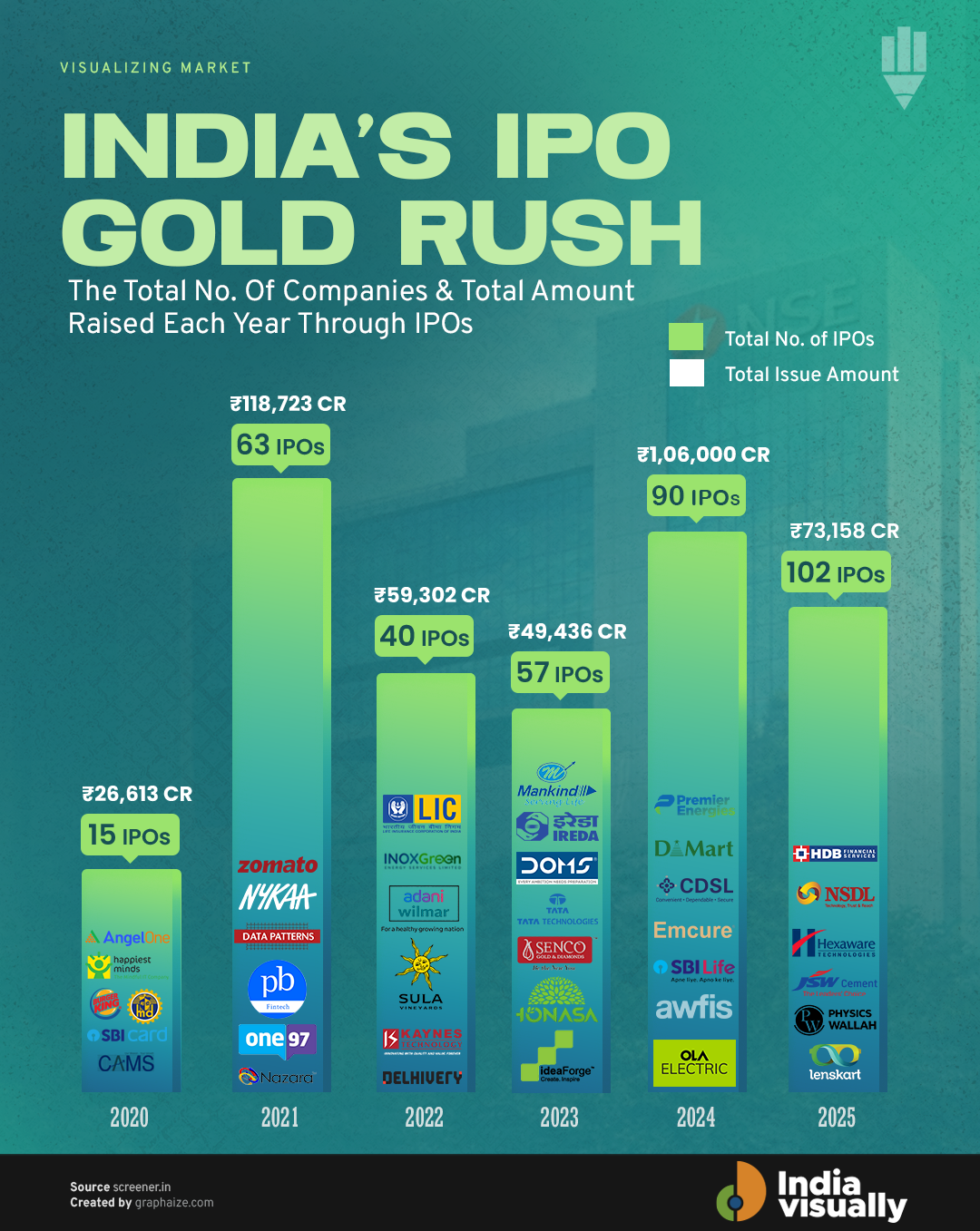
Over the last few years, the Indian stock market has witnessed a dramatic shift. IPOs, once occasional events, have become a regular feature of market conversations. From traditional manufacturers to digital-first brands, companies across sectors are tapping public markets at an unprecedented pace.
The Indian IPO market didn’t grow overnight. It evolved slowly at first, then rapidly shaped by global uncertainty, changing investor behavior, and improving market maturity. To understand this boom properly, we need to look at how IPO activity changed over time, how valuations widened, and why certain years stood out.
India’s IPO Growth Story (2020 to 2025)
The transformation of the Indian IPO market between 2020 and 2025 reflects a clear recovery to growth cycle.
In 2020, COVID 19 froze expansion plans. Only 15 mainboard IPOs hit the market, raising around ₹26,600 crore. Investor sentiment was cautious, and companies preferred to wait rather than test volatile markets.
That caution disappeared in 2021. With 63 IPOs and a record ₹1.18 lakh crore raised, India experienced a historic IPO boom in 2021. This year marked the arrival of consumer-tech and platform businesses into public markets, redefining what an IPO could look like.
2022 slowed things down again. Rising interest rates and global market stress reduced IPO activity to 40 listings, with fundraising of roughly ₹59,300 crore. While quieter, this year helped correct excess valuations and improve pricing discipline.
Momentum stabilized in 2023, with 57 IPOs raising about ₹49,400 crore. Mid sized, fundamentally strong companies dominated listings, signaling a more balanced and sustainable market.
The real breakout came in 2024, when 90 mainboard IPOs raised between ₹1.6 to 1.67 lakh crore. By 2025, the market hit another high, recording 102 IPOs, with the top 10 listings alone raising ₹73,158.48 crore. This six year journey firmly positioned India as one of the world’s most active IPO markets.
How India’s IPO Market Recovered After COVID
The pandemic initially damaged investor confidence, but it also reshaped market participation.
By late 2020, liquidity improved and retail investors entered the market in large numbers. Digital trading platforms made investing accessible, and IPOs became an easy entry point for new participants.
Regulatory improvements also played a role. Better disclosures, stronger governance expectations, and more realistic pricing helped restore trust. Investors became more selective, rewarding companies with clear business models and visibility on earnings.
As confidence returned, IPOs stopped being viewed as risky experiments and started being seen as long-term growth opportunities. This shift laid the foundation for the valuation expansion seen in later years.
Lower Valuation IPOs: Small Listings That Found the Market
The Indian IPO market also witnessed a steady flow of lower valuation listings, particularly during 2022 and 2023. These two years were shaped by global uncertainty, rising interest rates, and cautious investor sentiment, which naturally pushed companies to price their IPOs more conservatively.
The overall IPO environment during this phase reflects that caution clearly:
IPO Activity During the Lower Valuation Phase
| Year | Total Mainboard IPOs | Total Funds Raised (₹ crore) | Market Sentiment |
|---|---|---|---|
| 2022 | 40 companies | ₹59,300 crore | Volatile, valuation correction phase |
| 2023 | 57 companies | ₹49,400 crore | Stabilisation, selective investor demand |
These IPOs largely came from traditional and niche sectors such as infrastructure services, regional manufacturing, logistics, engineering, and specialised B2B businesses. Many of these companies entered the market at modest valuations, often in the ₹500 to 3,000 crore market cap range, with IPO sizes kept deliberately small to ensure successful subscriptions.
Valuations remained low for clear reasons. Growth expectations were moderate, margins were stable but not aggressive, and investors prioritised profitability, cash flows, and balance sheet strength over future heavy narratives. Companies responded by choosing realistic pricing instead of chasing premium multiples.
For retail investors, this phase offered a healthier risk reward balance. Conservative pricing reduced post listing volatility and allowed room for gradual long term compounding. Though these IPOs didn’t dominate news cycles, they played a crucial role in stabilising the Indian IPO market during uncertain times proving that strong fundamentals often matter more than size or hype.
Highest-Valuation IPOs: Blockbuster Listings That Defined the Boom
On the other end of the spectrum were high valuation IPOs, which became symbols of India’s capital market strength.
The most visible wave came in 2021, led by companies like Paytm, Zomato, and Nykaa. These listings introduced new age business models and attracted massive investor attention, despite valuation debates.
The next major valuation surge arrived in 2024, driven by large, established names such as Hyundai Motor India. Unlike earlier tech-driven listings, these IPOs were backed by strong revenues, global parentage, and predictable cash flows.
By 2025, high valuation IPOs were no longer exceptions. Financial services firms, consumer brands, and tech enabled platforms dominated fundraising, with the top 10 IPOs controlling a significant share of total capital raised.
These blockbuster listings showed that the Indian IPO market could support both scale and sophistication something few emerging markets manage consistently.
Why 2021 and 2024 Were Blockbuster IPO Years
Two years clearly stand above the rest in India’s IPO journey 2021 and 2024, though for very different reasons.
In 2021, global liquidity was abundant and interest rates were at historic lows. Investors were actively chasing growth and were more willing to back disruptive business models. The market mood was optimistic, and storytelling played a big role in IPO success. New age tech and consumer internet companies benefited the most, with high expectations driving strong demand and ambitious valuations. Risk appetite was high, and investors were comfortable betting on future potential rather than immediate profitability.
By contrast, 2024’s success was built on stability, not speculation. Investors were more seasoned, valuations were better aligned with fundamentals, and regulatory clarity improved confidence. Retail participation reached new highs, but decision making was more disciplined. IPOs succeeded because trust, earnings visibility, and market maturity replaced pure excitement.
Together, these years highlight the strength of the Indian IPO market capable of thriving in both high growth and value driven environments.
The Future of India’s IPO Market
From a cautious slowdown in 2020 to record-setting highs in 2025, the Indian IPO market has undergone a powerful transformation.
Lower valuation IPOs strengthened the market’s base, while high valuation listings pushed its global visibility. Together, they created a balanced ecosystem where companies of all sizes could access capital and investors could choose across risk profiles.
As India continues its economic expansion, IPOs will remain a key growth engine. The boom may evolve, but its significance to businesses, investors, and the broader economy is undeniable.
Unlock the power of captivating visuals with our seasoned expertise! With 7 years of crafting compelling visual content, we’re ready to elevate your brand’s story. From stunning graphics to mesmerizing animations, we bring your vision to life. Let’s create engaging visuals that resonate with your audience and leave a lasting impression. Partner with us today for an unforgettable visual journey!