
Startup Valuation India: Comparing India's Top 3 Start-Up Cities
India’s startup ecosystem has evolved rapidly over the last decade, but the real shift has happened in how companies are valued. The conversation around startup valuation in India has moved away from hype-driven numbers toward more realistic, sustainability-focused figures. Today, Mumbai, Bangalore, and Delhi NCR stand out as the three cities shaping this valuation narrative, each contributing high-value startups across fintech, education, commerce, and consumer platforms.
This article takes a grounded look at how startup valuations compare across these cities, using latest known and stabilized figures rather than speculative future estimates.
Overview of India’s Startup Valuation Landscape
India’s startup ecosystem continues to grow across diverse sectors, but the valuation environment has clearly matured. After the funding boom of 2020–2021, the market entered a correction phase where startups began to be priced more carefully. Investors now look closely at scalability, revenue models, and operational discipline before assigning high valuations.
Mumbai, Bangalore, and Delhi NCR dominate this landscape not just because of the number of startups they produce, but because of the quality and scale of businesses emerging from these regions. The valuations discussed today reflect this post-correction mindset, offering a realistic snapshot of where India’s startup economy currently stands.
Major Cities in the Indian Startup Landscape
India’s startup growth is not evenly distributed, and that’s largely because a few cities offer ecosystem advantages that are hard to replicate. Mumbai, Bangalore, and Delhi NCR have emerged as dominant startup hubs, each shaped by its own economic and structural strengths. Mumbai benefits from financial depth, regulatory proximity, and access to institutional capital, making it ideal for startups that require trust, compliance, and monetisation discipline.
Bangalore, on the other hand, thrives on deep technology talent, global venture capital presence, and a culture of product-led innovation, allowing startups to build for scale from day one. Delhi NCR stands out for its proximity to large consumer markets, strong distribution networks, and brand-driven growth models.
Rather than competing, these cities function as complementary pillars, together supporting the majority of India’s high-value startups and attracting sustained domestic and global investment.
Startup Valuation in India: City-Wise Comparison
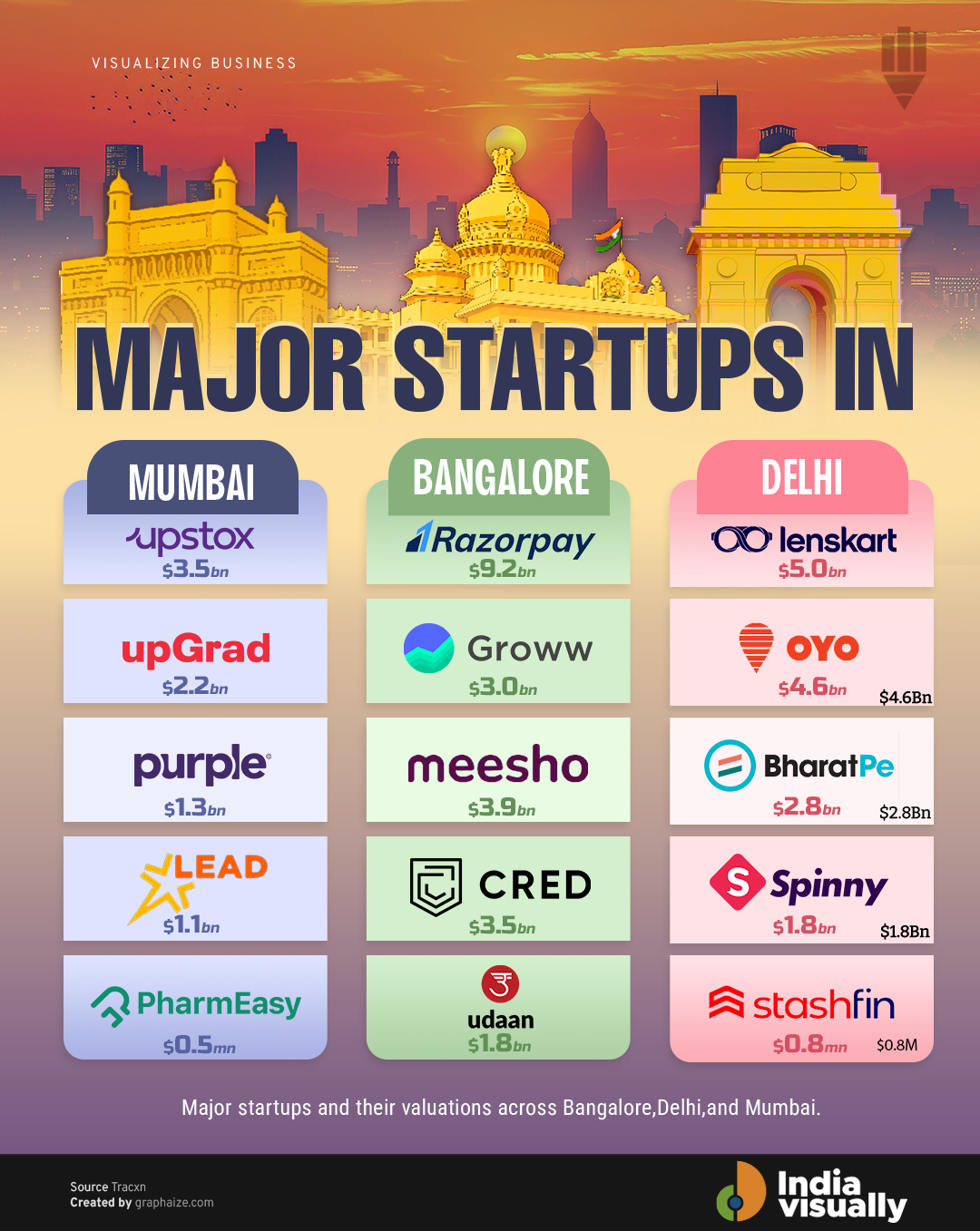
Summarizes the latest known across India’s top three startup hubs, based strictly on the data shown in the chart.
| City | Startup | Valuation as of 2025 | Category |
|---|---|---|---|
| Mumbai | Upstox | $3.5 Billion | Trading & Investment Platform |
| Mumbai | upGrad | $2.25 Billion | EdTech & Upskilling |
| Mumbai | Purple | $1.3 Billion | Beauty E-commerce |
| Mumbai | LEAD School | $1.1 Billion | School Education Platform |
| Mumbai | PharmEasy | $456 Million | Online Pharmacy |
| Bangalore | Razorpay | $9.2 Billion | Payments Infrastructure |
| Bangalore | Groww | $3.0 Billion | Investment Platform |
| Bangalore | Meesho | $3.9 Billion | Social Commerce |
| Bangalore | CRED | $3.5 Billion | Credit & Rewards Platform |
| Bangalore | Udaan | $1.8 Billion | B2B Commerce |
| Delhi NCR | Lenskart | $5.0 Billion | Eyewear & Retail |
| Delhi NCR | OYO | $4.6 Billion | Hospitality Platform |
| Delhi NCR | BharatPe | $2.8 Billion | Merchant Payments |
| Delhi NCR | Spinny | $1.8 Billion | Used-Car Marketplace |
| Delhi NCR | Stashfin | $800 Million | Digital Lending |
This comparison highlights how valuations are distributed across cities and sectors, with clear leaders emerging in each hub.
Mumbai: The Financial Capital
Mumbai’s startup ecosystem is deeply shaped by its role as India’s financial nerve center. Home to major banks, stock exchanges, venture capital firms, regulators, and legacy corporations, the city offers an environment where startups are built with monetisation and compliance in mind from day one. Unlike ecosystems driven purely by experimentation, Mumbai startups often grow alongside real revenue streams, which plays a crucial role in how they are valued.
This financial proximity makes Mumbai especially strong in fintech, edtech, and consumer platforms that require trust, regulation, and long-term customer relationships. Startups here benefit from easier access to institutional capital, experienced leadership, and a deep understanding of India’s financial behavior. As a result, valuations tend to be more stable and less volatile compared to hype-driven cycles.
Platforms like Upstox highlight Mumbai’s ability to tap into India’s expanding retail investor base. The rise of equity participation, digital trading, and financial awareness has allowed such platforms to scale responsibly while maintaining strong valuation benchmarks. Similarly, upGrad reflects the city’s alignment with professional education and career-driven learning, serving working professionals rather than mass-market users.
Mumbai also demonstrates how focused, niche platforms can still achieve unicorn status. Consumer-first brands like Purple have succeeded by understanding audience segmentation and brand loyalty, while education-focused platforms such as LEAD School show how deep engagement within a specific vertical can drive scale. Even valuation corrections, such as in PharmEasy, reflect ecosystem maturity rather than failure.
Looking ahead, Mumbai continues to produce emerging startups in wealth management, insurtech, creator-led commerce, and enterprise SaaS, positioning it as a steady and disciplined contributor to India’s startup valuation landscape.
Bangalore: Silicon Valley of India
Bangalore has long been recognised as the technology capital of India, and its dominance in startup valuations is no coincidence. The city’s ecosystem is powered by a dense concentration of engineering talent, global venture capital, startup accelerators, and multinational R&D centers. This combination creates startups that are designed for scale-first execution, often targeting national or global markets from the very beginning.
What sets Bangalore apart is its culture of product-led growth. Startups here typically focus on building strong technology foundations before aggressive expansion, which directly influences higher long-term valuations. Investors view Bangalore-based startups as globally competitive, especially in fintech, SaaS, and platform infrastructure.
A clear example is Razorpay, the highest-valued company in your list. Its valuation reflects not just growth, but its role as core infrastructure for India’s digital economy. Similarly, platforms like Groww benefit from Bangalore’s fintech expertise, serving millions of first-time investors with tech-driven simplicity.
Bangalore’s ecosystem also excels in new-age commerce and premium fintech platforms. Meesho shows how technology can enable mass entrepreneurship through reseller models, while CRED represents a different approach—targeting high-value users with a premium positioning. Even B2B platforms like Udaan demonstrate how enterprise-focused models can sustain large valuations.
Beyond the companies listed, Bangalore continues to be a breeding ground for SaaS, AI, climate tech, health tech, and developer tools. This makes the city not just a current leader, but the long-term innovation engine of India’s startup ecosystem.
Delhi and NCR: The New Generation IT Destination
Delhi NCR has rapidly evolved into one of India’s most influential startup hubs, driven by consumer reach, brand visibility, and execution at scale. Unlike Bangalore’s tech-first orientation or Mumbai’s financial discipline, Delhi’s ecosystem thrives on understanding mass-market behavior and distribution.
Startups in this region often scale quickly because they operate close to India’s largest consumption markets. Strong logistics networks, marketing ecosystems, and access to a diverse customer base allow Delhi NCR startups to achieve rapid adoption—an important factor in valuation growth.
Brands like Lenskart demonstrate how omnichannel execution can translate into multi-billion-dollar valuations. By combining online reach with offline presence, such platforms reflect Delhi NCR’s strength in blending technology with physical scale. Similarly, OYO highlights how large-scale execution across cities and geographies can sustain significant valuations even after market corrections.
The region also hosts a wide variety of platforms beyond traditional consumer tech. Companies like BharatPe, Spinny, and Stashfin show how Delhi NCR supports diverse business models—from payments and mobility to lending and marketplaces.
With increasing momentum in logistics, D2C brands, enterprise services, and platform-led businesses, Delhi NCR is no longer just a consumer hub. It is steadily becoming a new-generation IT and platform destination, capable of producing the next wave of high-valuation startups.
Final Takeaway
The current state of startup valuation in India tells a clear story. This is no longer an ecosystem driven by inflated expectations. Instead, Mumbai, Bangalore, and Delhi NCR each contribute in different but complementary ways—financial discipline, technology-led scale, and consumer reach. Together, they offer a realistic, balanced view of India’s startup economy today: mature, competitive, and built for long-term growth.
Unlock the power of captivating visuals with our seasoned expertise! With 7 years of crafting compelling visual content, we’re ready to elevate your brand’s story. From stunning graphics to mesmerizing animations, we bring your vision to life. Let’s create engaging visuals that resonate with your audience and leave a lasting impression. Partner with us today for an unforgettable visual journey!