

Why Financial Startups Lose Users Due to Lack of Real Market Need
There’s a statistic that should make every founder pause: around 42% of startups fail because there is no real market need. That’s not a small margin of error. That’s nearly half.
In fintech, this usually happens when founders build solutions they personally find exciting but users don’t urgently need. For example, creating a highly advanced investment analytics tool when the target audience is still struggling with basic budgeting.
The product may function flawlessly. The technology may be impressive. But if the problem isn’t pressing, engagement will fade quickly.
This disconnect is one of the foundational explanations for why financial startups lose users. It’s not rejection — it’s indifference.

How to Fix It: Validate with an MVP Before You Scale
The solution isn’t better marketing. It’s better validation.
Before investing heavily in full development, financial startups should build a Minimum Viable Product (MVP) — the simplest version of the product that solves one clear, urgent problem. Not ten features. Not a polished dashboard. Just one core value that delivers immediate benefit.
For example, instead of building a complete investment analytics platform, test a simplified tool that helps users track one financial goal. Measure what happens next:
- Do users return without reminders?
- Do they complete the key action?
- Do they share it with others?
Are they willing to pay — even a small amount?
Real validation comes from behavior, not opinions. Interviews are helpful, but usage data is truth.
Before scaling, watch how users interact in real time. Track engagement. Monitor drop-offs. Identify friction points. Refine based on actual behavior.
If users repeatedly come back because the product genuinely solves a pressing problem, you’re approaching product–market fit.
If they don’t, scaling will only amplify failure.
Why Financial Startups Lose Users When Product–Market Fit Is Slightly Off
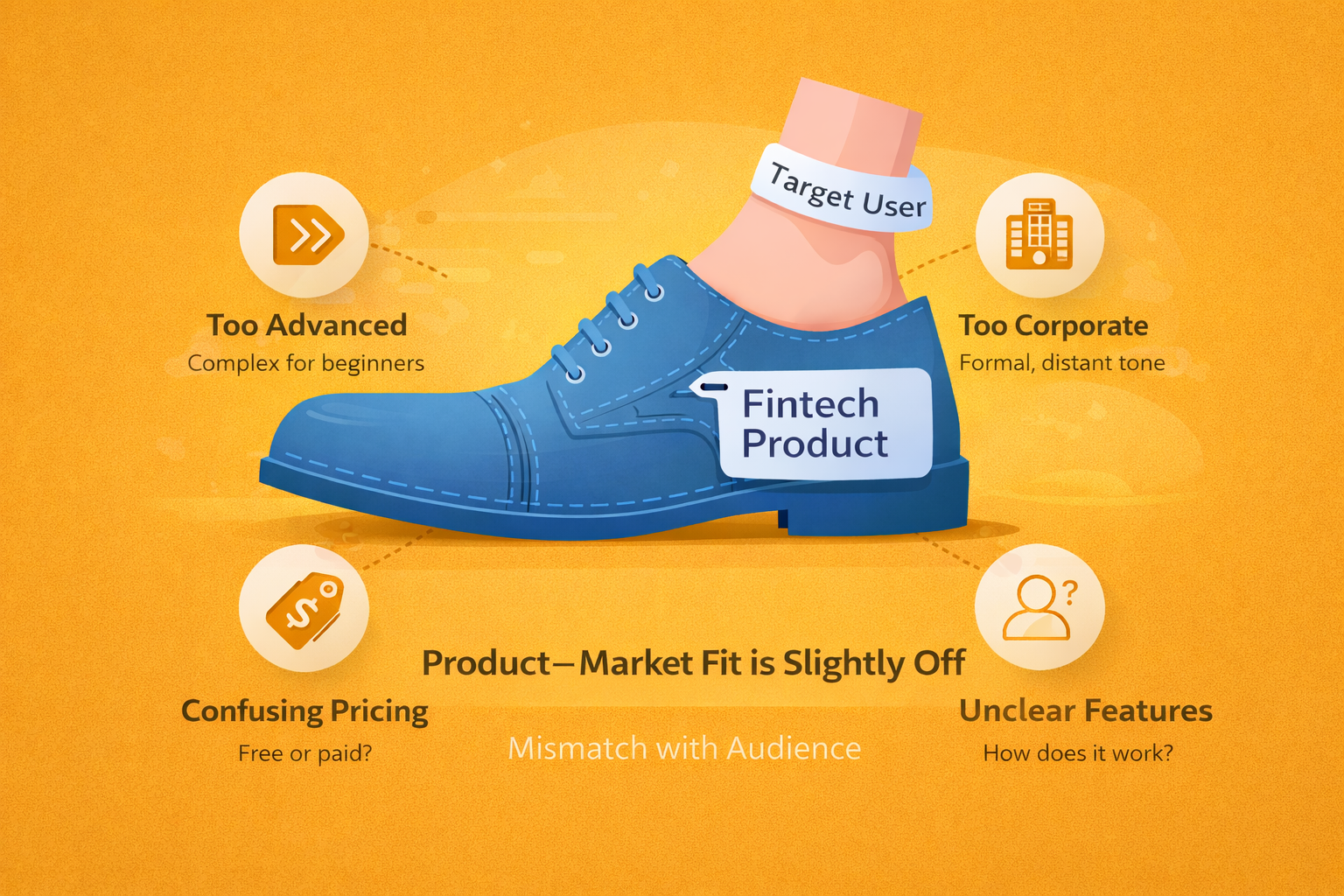
Even when real demand exists, subtle misalignment can quietly destroy retention. Around 13% of startups fail due to poor product–market fit — not because the idea is wrong, but because the fit isn’t precise enough. In fintech, that gap doesn’t usually explode overnight. It slowly erodes trust, engagement, and consistency.
Product–market fit isn’t just about having users. It’s about attracting the right users with the right expectations.
For example, your platform might be designed for experienced investors who understand risk allocation and portfolio balancing. But your marketing campaigns may attract beginners who are simply looking to start saving. The product works perfectly — but for a different audience. That disconnect creates friction.
Or your pricing model might assume users have strong disposable income, while your actual audience is budget-conscious. Or your tone might sound highly corporate and technical, while your users want clarity and simplicity.
None of these mistakes feel dramatic. But over time, they push users away.
How to Fix It: Test Positioning with Targeted Video Experiments
When product–market fit feels slightly off, the problem isn’t always the product — it’s often the positioning.
Instead of rebuilding features immediately, test how different audiences respond to the same product through targeted messaging experiments. One of the fastest and most effective ways to do this is with short, specifically designed explainer videos tailored to different user segments.
For example:
Create one video for experienced investors focusing on portfolio optimization and risk control.
Create another for beginners emphasizing simplicity and financial confidence.
Create a third targeting young professionals, highlighting automation and convenience.
Keep the product the same. Change the framing.
Then measure:
- Which audience engages more?
- Which version drives longer session time?
- Which group converts at a higher rate?
- Which messaging reduces onboarding drop-off?
Video works particularly well for this because it allows you to adjust tone, language, benefits, and emotional triggers quickly without rebuilding your platform.
Based on real behavioral data, you can pivot your positioning — refining who you target, how you communicate, and what benefits you emphasize.
Product–market fit is not static. It’s discovered through iteration.
If one audience doesn’t resonate, that doesn’t mean the product is broken. It may simply mean the story is misaligned.
When the right positioning meets the right audience, retention improves naturally — without forcing growth.
Why Financial Startups Lose Users Due to Weak Trust Signals
Trust in fintech isn’t built solely on encryption. It’s built on perception.
Users look for cues:
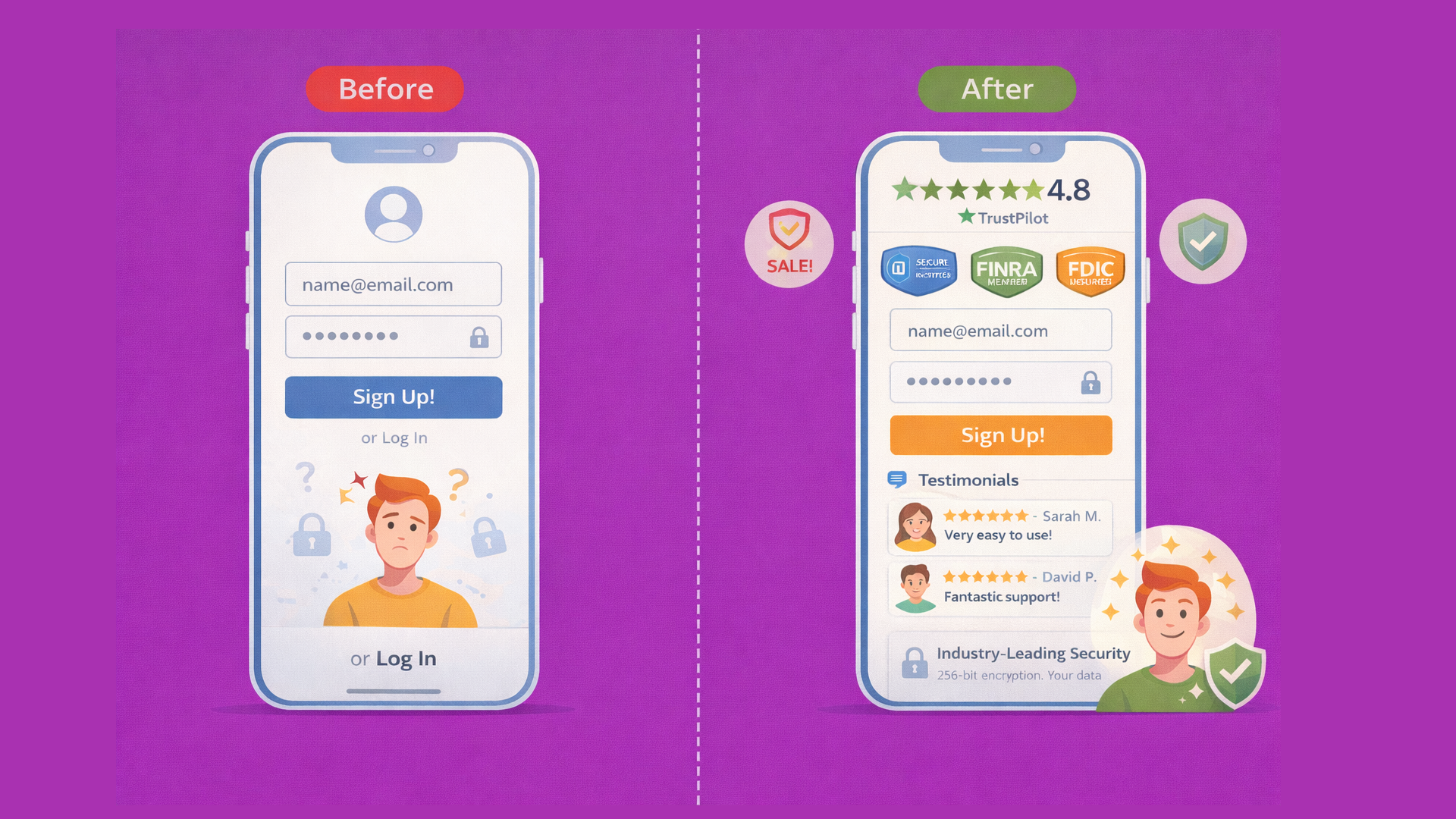
- Clear compliance statements
- Recognizable partnerships
- Real testimonials
- Transparent privacy explanations
If those elements are missing or buried, users feel uncertain.
And uncertainty in finance feels dangerous.
Even design plays a role. Slow loading times, outdated visuals, or cluttered layouts subtly signal instability. This is another overlooked reason why financial startups lose users — not because they are insecure, but because they appear uncertain.
How to Strengthen Trust Signals
Trust in fintech is not assumed — it is earned visually and socially.
Encryption badges and compliance statements are important, but they are not enough. Users don’t just want to know your system is secure. They want proof that real people trust you.
This is where social validation becomes powerful.
Positive reviews reduce perceived risk. Detailed testimonials show that your product works in real scenarios. And video testimonials, in particular, create emotional reassurance that text alone cannot.
When potential users see someone like them explaining how your app helped them save money, manage investments, or feel more financially secure, hesitation decreases. Familiarity builds safety.
Short testimonial videos are especially effective because they:
- Humanize your brand
- Demonstrate real outcomes
- Reduce fear of financial mistakes
- Provide credibility beyond marketing claims
Displaying verified user reviews, ratings, and short customer success stories near onboarding or pricing pages can significantly improve retention.
In finance, trust is not built through promises. It’s built through proof.
Why Financial Startups Lose Users Because of Weak Internal Strategy
Sometimes churn doesn’t start on the screen. It starts behind the scenes. Many founders assume that user loss is always a UX or marketing issue, but in reality, internal instability often shows up externally. Poor financial planning, unclear business models, and unrealistic growth expectations quietly weaken the foundation of the company.
When startups raise funds too early, they often feel pressure to grow aggressively. Overspending begins. Teams expand before systems are ready. New features are rushed out. On the other hand, raising funds too late creates cash flow stress, forcing reactive decisions instead of strategic ones. Both scenarios create operational strain.

Choosing investors who don’t align with your long-term vision can also push you toward chasing short-term metrics instead of building sustainable value. And when scaling happens before operational systems are mature, customer support declines, product quality slips, and response times increase.
Users may never see the internal chaos directly. But they feel its impact.
Financial startups lose users not just because of front-end friction, but because backend instability slowly leaks into the user experience.
Stability Before Scale
Prioritize operational readiness before aggressive expansion. Align investors with your long-term mission. Build strong systems before increasing volume. Sustainable growth retains users far better than dramatic growth ever will.
Why Financial Startups Lose Users in Competitive Markets
Another major reason why financial startups lose users is simple: the market is crowded. You’re not just competing with other new startups. You’re competing with established banks, global fintech platforms, and trusted legacy institutions that already have brand recognition and user trust. In such an environment, innovation alone isn’t enough.
Many startups assume that better technology automatically means better retention. But users don’t stay because you’re innovative — they stay because they clearly understand why you’re different. When your messaging sounds similar to everyone else’s, your product becomes interchangeable. And when products feel interchangeable, users leave easily.

Weak brand positioning accelerates churn. If users can’t quickly identify your unique value, they won’t feel a strong reason to commit.
This is where communication becomes a competitive advantage. For example, a well-crafted B2B Explainer Video can simplify complex financial solutions for enterprise decision-makers. Educational storytelling, whether through content, visuals, or guided demos, builds clarity and authority.
Marketing isn’t decoration. It’s explanation. And in fintech, the clearest brand often wins.
Why Financial Startups Lose Users Because They Overwhelm Them
One of the quieter but powerful reasons why financial startups lose users is feature overload. In the early stages, founders often feel pressure to demonstrate innovation and capability. So they pack the product with dashboards, analytics, investment tracking, credit monitoring, budgeting tools, insurance comparisons, and advanced reports — all available from day one. On paper, it looks impressive. It feels comprehensive.
But to a new user, it feels overwhelming.
Most people don’t open a financial app thinking, “Show me everything you can do.” They open it with a specific goal — to solve one clear problem. When they’re confronted with too many choices at once, cognitive overload sets in. They hesitate because they don’t know where to begin. That hesitation creates friction. And friction increases churn.
Complexity does not equal sophistication. In fintech, clarity equals confidence.

How to Simplify Without Losing Power (With Video Strategy)
Simplification doesn’t mean removing power. It means structuring power.
Instead of presenting your entire ecosystem upfront, break your product into smaller, benefit-driven layers. Each feature should answer one simple question: “What specific problem does this solve?”
For example:Instead of showing a full financial dashboard immediately, introduce one focused module — such as automatic expense tracking. Once users engage comfortably, gradually introduce goal tracking, then investment insights, then advanced analytics.
This progressive exposure reduces anxiety while maintaining depth.
Video can accelerate this clarity.
Instead of overwhelming users with menus, create short, benefit-focused explainer videos for each major feature:
- One video explaining budgeting in 60 seconds
- One video focused on automated investing
- One video explaining risk management simply
Each video should focus on outcome, not mechanics.
This modular storytelling allows users to explore features at their own pace. They feel guided rather than flooded.
When users understand one benefit clearly, they build confidence. And when confidence grows, exploration follows naturally.
Power doesn’t retain users. Structured clarity does.